The Crucial Role of Dustproof Micro Switches in Soy Milk Makers
Soy milk makers must perform a variety of functions—grinding, heating, lid detection, and automated program control—all within a limited internal space. Users frequently open and close the lid when adding beans and water, pouring out the soy milk, or cleaning the appliance. During these processes, dry bean dust and fine food particles can easily accumulate around the lid latches and moving parts. If the device lacks adequate dust protection, such debris can readily cause the soy milk maker to malfunction.
In a soy milk maker, a dustproof micro switch serves to prevent external particles from entering the internal contact mechanism. This ensures that the switch’s position-sensing function remains stable over long-term use. This article explores the role and operating principle of dustproof micro switches in soy milk makers, as well as the key parameters that manufacturers should evaluate during the design phase, providing a deeper understanding of these components.
Why the Soy Milk Maker Environment Demands a Dustproof Micro Switch
Soy milk makers handle dry beans, soaked beans, and ground mixtures, all within a relatively compact internal structure. During the addition of ingredients, fine food particles may settle around the lid, latches, and moving components; likewise, food residue may remain in these areas after use. Furthermore, because the lid is opened and closed repeatedly, the switch is subjected to constant mechanical actuation while remaining exposed to fine particles over an extended period.
If particles penetrate the contact area, they can interfere with contact closure or the movement of the snap action mechanism. This may lead to unstable signals, intermittent operation, or a failure of the control board to correctly detect the position of the lid. Consequently, soy milk makers require dustproof micro switches—compact switches designed with dust-exclusion features at housing joints, around the actuator, and at the terminal exit points—to minimize the pathways through which particles can enter the internal mechanism. This helps maintain the switch’s intended performance, allowing engineers to properly assess the component by considering factors such as installation orientation, surrounding clearances, and the potential impact of debris.
How a Dustproof Micro Switch Works in a Soy Milk Maker
In typical designs, the control system must verify that the lid or other mechanical components are in their designated positions before allowing the appliance to proceed with its operating cycle. A dustproof micro switch serves as a critical component in the lid-detection circuit by converting mechanical positional changes into electrical signals that the control board can recognize.
Lid Detection and Safety Interlock
Micro switches can be installed near the lid latches or interlocking mechanisms. When the lid reaches its intended position, a protrusion, latch, or push-rod on the lid presses against the switch’s actuator, causing the contacts to change state. Upon receiving this signal, the control board—following the appliance’s internal logic—determines whether to initiate the requested operation. If the lid is not properly positioned, the control board receives a different signal state, which prevents the appliance from starting.
Snap Action and Repeated Daily Operation
The "snap action" mechanism ensures that the contacts switch state rapidly once the actuator reaches the operating point, providing the control board with a clear, unambiguous signal. Since the lid of a soy milk maker is frequently opened and closed—during ingredient loading, pouring, and cleaning—the selection of a switch must account for the expected number of operations, the actual electrical load, and the target service life of the appliance.
Soy Milk Maker Market Data and Key Considerations for Switch Selection
According to the "Soy Milk Maker Market Insight Report (January–August 2025)" published by Huaxinren Consulting, the combined online sales of soy milk makers across Tmall, JD.com, and Tiktok reached approximately 600 million RMB between January and August 2025. Monthly sales figures fluctuated, peaking in March. It should be noted that these statistics reflect online sales on specific platforms and do not directly represent the total market size for micro switches.
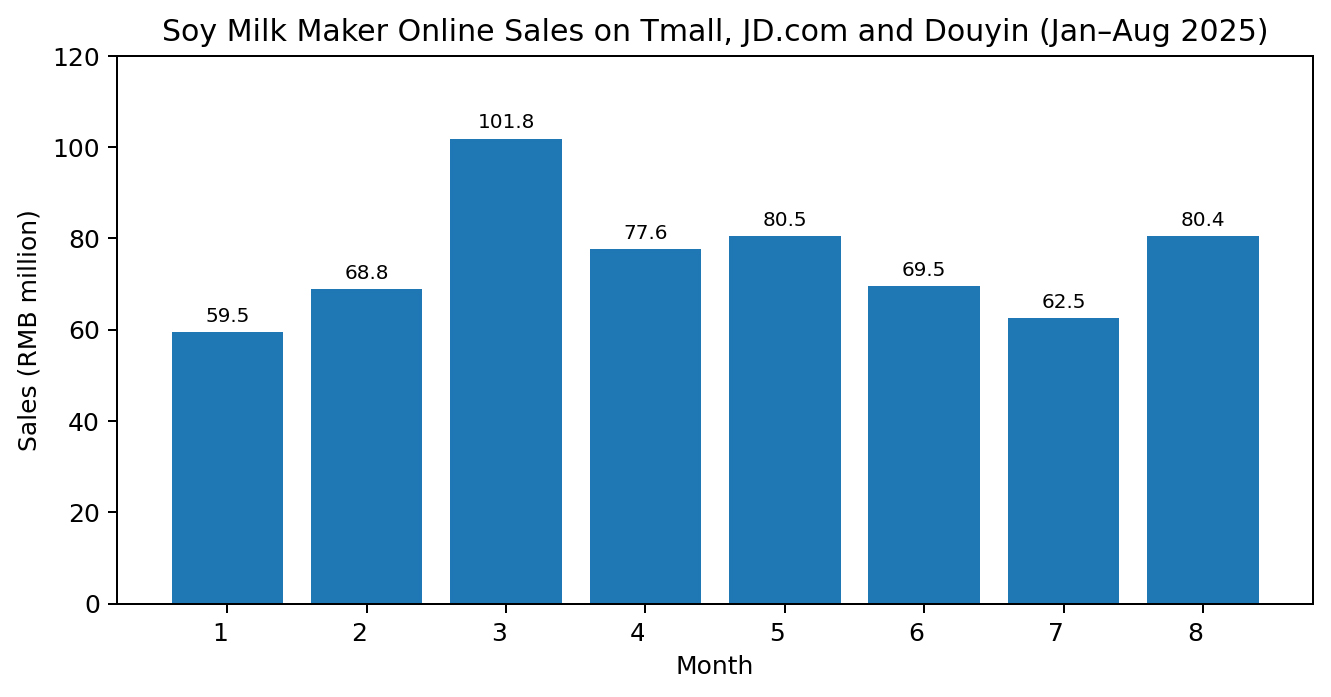
Total Online Sales of Soy Milk Makers (January–August 2025)
A survey of 1,266 consumers in the same report indicates that 27% of respondents use their soy milk makers daily, while 31% use them 3 to 5 times per week. This suggests that a significant number of users employ these appliances with high frequency. For manufacturers, the position-detection switch located at the lid must remain stable throughout repeated use; furthermore, a dust-proof design helps mitigate the risk of small particles interfering with the switch’s internal mechanism.
Key Selection Checks for Soy Milk Maker Applications
1. Determine whether the switch is intended for low-current position detection or for directly switching higher electrical loads; verify the rated values and contact materials accordingly.
2. Ensure that the operating force, pre-travel, over-travel, and actuator type are compatible with the lid’s locking mechanism or linkage structure to guarantee reliable switching while preventing excessive mechanical stress.
3. Evaluate the mechanical and electrical lifespan in relation to the appliance’s expected frequency of use, and confirm the operating temperature range based on the specific installation location.
4. Verify the terminal type, mounting dimensions, and any product certifications required for the target market. Since rated parameters vary by model, always refer to the specific technical specifications provided by the supplier before proceeding to mass production.
FAQ
Q1: Where is a dustproof micro switch typically installed in a soy milk maker?
A1: Common locations include near the lid latch or within the linkage mechanisms designed to verify that mechanical components are correctly positioned.
Q2: Does a micro switch drive the motor directly?
A3: Not necessarily. In most cases, a micro switch serves only to output a position-detection signal; the motor itself is controlled by a control board or a relay circuit.
Q3: What are the consequences of an unstable lid-detection signal?
A3: The appliance may fail to start, exhibit intermittent malfunctions, or be unable to accurately detect whether the lid is properly in place.
Q4: How can one determine if a micro switch’s lifespan is sufficient?
A4: You should evaluate both its mechanical lifespan and its electrical lifespan under actual load conditions, while also considering the expected frequency of use for the appliance as a whole.
Q5: What information should be provided when requesting a quote from a micro switch supplier?
A5: It is advisable to provide details regarding electrical load, rating requirements, operating force and travel (stroke), mounting dimensions, terminal type, target lifespan, and operating temperature.
Conclusion
Because a soy milk maker integrates high-speed blade assemblies, high-temperature cooking, and frequent lid handling into a compact unit, it places high demands on its detection components. The device must perform lid detection and automated control within a confined space, where fine powder or food residue could potentially interfere with the internal contact mechanism of a switch. A dustproof micro switch uses a specialized structural design to minimize the ingress of particles, while reliably converting the mechanical movement of components—such as the lid—into a clear electrical signal.
During the design phase, manufacturers should carefully define the requirements for the dustproof micro switch—including its mounting position, actuator travel, electrical load, and lifespan—in consultation with the micro switch manufacturer. This helps minimize the need for subsequent design revisions, ensures consistency in mass production, and ultimately enhances the user experience.
Sealed vs Unsealed Micro Switches: How to Choose the Right Type
Related Article