Sealed vs Unsealed Micro Switches: How to Choose the Right Type
When selecting a micro switch, the choice between a sealed and an unsealed version is often oversimplified as "sealed for damp environments, unsealed for dry ones." In reality, this dichotomy is not entirely accurate. The decision to use a sealed or unsealed switch should be based on a comprehensive assessment—considering factors such as installation location, the nature of potential contaminants, cleaning methods, the risk of condensation, and the overall protection strategy for the device—rather than relying solely on environmental humidity.
The primary function of a sealed micro switch is to create a protective barrier between the actuator and the contact chamber, preventing the ingress of substances like water or dust. However, a sealed design can also affect operating force, travel, physical dimensions, and maintenance requirements. Therefore, the key to proper selection lies in determining whether the installation site necessitates a seal, and whether a sealed switch can still meet the mechanical requirements of the application. This article provides a detailed analysis to help you gain a deeper understanding of this topic.
What Separates a Sealed Micro Switch from an Unsealed One?
Micro Switch – Same Snap Action Mechanism, Different Housing Strategies
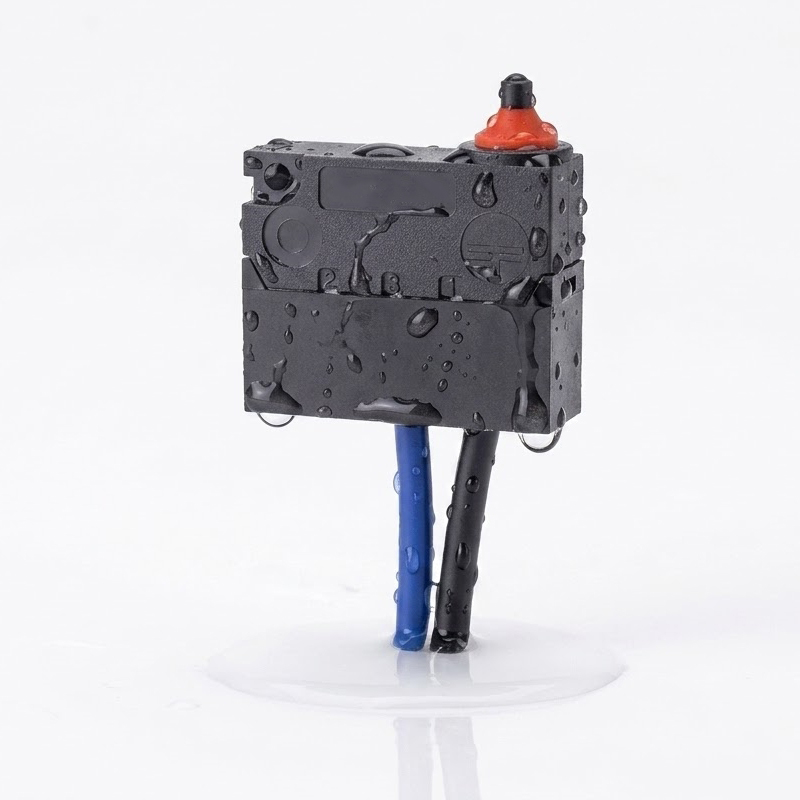
A sealed micro switch requires protection at four critical points: housing seams, the moving parts of the actuator, terminal connections, and cable exits. These four areas collectively determine the product's overall level of protection; a failure at any one point can allow moisture or dust to enter the contact chamber. Consequently, it is difficult for a sealed micro switch and an unsealed micro switch to be identical across all technical specifications.
What Micro Switch Sealing Covers—and What It Does Not
Sealing is primarily designed to block substances such as liquid water, dust, and oil mist, with the level of protection typically indicated by an IP (Ingress Protection) rating. However, an IP rating does not account for factors like chemical resistance, temperature range, tolerance to pressure differentials, or long-term durability. In practical applications, the selection must be based on a holistic evaluation of all relevant conditions.
The Full Cost of Choosing a Sealed Micro Switch
How Sealing Components Affect Operating Force and Travel
The elasticity of a diaphragm adds to the force exerted on the internal mechanism, altering the operating force, reset characteristics, and differential travel. In mechanisms requiring a light touch, the additional resistance introduced by the diaphragm may prevent the switch from fully actuating. Furthermore, friction from the sealing components can accentuate the variance between the actuation point and the reset point. This is particularly critical in precision positioning and counting applications, where the repeatability of the actuation point should be verified rather than relying solely on nominal specifications.
Volume, Mounting, and Service Access
Sealed designs require additional mounting surface area, space for the diaphragm to flex, and provisions for cable securing. Consequently, selection must account for cable bend radii, mounting hole positioning, and sufficient clearance for maintenance tools. Moreover, the mounting orientation can impact long-term reliability; if the actuator recess is prone to collecting water or dust, the aging of the sealing components will likely accelerate. Designs should minimize the potential for debris or fluid accumulation and incorporate effective drainage paths—relying on an IP rating alone is insufficient.
Unit Price vs. Cost of Failure
While a sealed micro switch may carry a significantly higher unit price than a basic micro switch, procurement cost should not be the sole criterion for selection. Equipment failure can lead to downtime, labor costs for repairs, batch traceability issues, and rework expenses. A more accurate assessment of total cost requires weighing these potential expenses against the difference in purchase price.
Additionally, when a micro switch is used for safety interlocking, economic considerations must be secondary to preventing serious safety hazards resulting from failure. Such applications require a "fail-safe" logic based on a formal risk assessment, along with the selection of appropriate contact configurations or redundant systems.
When an Unsealed Micro Switch Is the Better Choice
Clean, Dry, and Enclosed Environments
If a switch is to be installed within a dry, enclosed electrical cabinet—free from condensation, conductive dust, or exposure to liquids—a standard (unsealed) micro switch is typically sufficient. Such switches offer greater flexibility regarding operating force and travel specifications, while avoiding the unnecessary costs associated with sealing. In such an environment, an additional sealing structure is not only cost-ineffective but also fails to provide any meaningful practical benefit.
Where the Micro Switch Resides Within a Secondary Enclosure
If a micro switch is already installed inside a reliable secondary enclosure, adding further sealing specifically for the switch itself may be unnecessary. However, this assumes that the actual protective capability of the enclosure has been verified—including the integrity of cable entries, the condition of seals (checking for aging), and the potential for moisture exchange caused by temperature cycling. Otherwise, even with a dual-sealing approach, the device could still fail due to other points of ingress or internal condensation.
Comparison Table: Sealed vs Unsealed Micro Switches Across Eight Decision Points
|
Decision Point |
Unsealed Micro Switch |
Sealed Micro Switch |
Decision Key Points |
|
Actuator Exposure |
The actuator is directly exposed to the air; process media can freely contact the plunger and guide hole. |
A diaphragm or lip seal separates the plunger from the outside world; media stops at the sealing surface. |
Check if process media will hit the actuator directly. If it is only inside an enclosure, address the enclosure seal first. |
|
Media State |
Suitable only for dry air and a small amount of non-conductive dust. |
Can handle splashing water, water jets, brief immersion, oil mist, and conductive dust. |
Choose sealed types for spraying and immersion. Pure condensation cannot be resolved by sealing alone. |
|
Operating Force Budget |
Full range available; light-touch mechanisms can go as low as the 25gf class. |
Superimposed diaphragm elasticity noticeably narrows the selection in low-force ranges. |
The mechanism's remaining margin should be no less than 1.5 times the operating force, verified by measuring the entire assembly. |
|
Differential Travel |
Sharp snap action allows for smaller differential travel. |
Seal resilience and friction slightly increase differential travel, making hysteresis more pronounced. |
Verify operating point repeatability in applications requiring high-frequency, precise positioning. |
|
Dimensions & Mounting |
Thin housing; terminals can be soldered directly; flexible wiring. |
Thicker housing to accommodate sealing surfaces; cable outlets require space for bending radius. |
The mounting envelope must leave room for cable glands and maintenance; do not evaluate based solely on the switch body width. |
|
Electrical Load |
Independent of ingress protection; calculated separately based on DC ratings and inrush currents. |
Also independent of ingress protection; do not assume sealed types carry higher current. |
Select contact materials for both types based on actual load; do not infer ratings from IP protection class. |
|
Maintainability |
Cleanable, visually inspectable, and locally replaceable. |
Non-dismantable with hidden failures; must be replaced as a whole unit. |
Factor replacement labor hours and downtime losses into the total cost calculations. |
|
Total Cost |
Low unit price, but the cost of a single unplanned downtime can far exceed the price difference. |
Unit price is typically 1.5 to 3 times that of standard unsealed types. |
Compare costs by multiplying single failure cost by annual failure frequency, rather than focusing solely on unit price. |
Five Stress Conditions That Determine Micro Switch Selection
Liquid Exposure: Spray, Immersion, and Condensation
The intrusion mechanisms for water spray, immersion, and condensation differ. Water spray primarily tests the ability of a sealed structure to withstand the impact of a water stream. Immersion introduces additional factors such as hydrostatic pressure, mounting orientation, and pressure differentials between the interior and exterior. Condensation is linked to moisture exchange and temperature fluctuations; therefore, for equipment subject to significant temperature changes, considerations must include moisture-permeable design, desiccation measures, and internal cavity configuration.
Conductive Dust
Non-conductive dust (such as wood shavings or cement dust) typically increases mechanical friction and wear. In contrast, conductive dust (such as metal filings or graphite) can cause short circuits, unintended operation, or a degradation in insulation. Since the nature of contamination varies significantly by environment, selection must be based on a specific assessment of the dust—considering its conductivity, particle size, and potential for accumulation—rather than applying a one-size-fits-all approach.
Temperature Cycling and the "Breathing" Effect
The magnitude of temperature fluctuations, the frequency of cycles, and the free volume within an enclosure all influence the "breathing" effect. More frequent temperature changes increase the risk of moisture accumulation and condensation inside the cavity. Effective solutions include minimizing unnecessary internal space, incorporating appropriate humidity-control features, and optimizing the thermal management of the entire system, rather than relying solely on increasing the level of sealing.
Chemical Exposure During Wash-down
Equipment used in food processing, medical, or chemical applications may be exposed to substances such as alkaline cleaners, chlorine-based disinfectants, or acidic descaling agents. These agents can cause sealing materials to swell, harden, or crack. It is important to note that an IP rating does not guarantee chemical resistance; therefore, the compatibility of sealing materials with the specific substances encountered must be verified—if necessary, by requesting relevant test data from the supplier.
Vibration and Low Temperatures
Continuous vibration can lead to loose fasteners, shifts in mounting position, and uneven stress distribution across sealing surfaces. In low-temperature environments, water that enters the gaps around an actuator may freeze and expand, potentially causing the actuator to jam or damaging the sealing components. For outdoor equipment, cold storage facilities, and winter transport applications, the risks of vibration, low temperatures, and icing should be incorporated into the validation plan, and the suitability of sealing materials must be verified.
FAQ
Q1: Can a sealed micro switch still corrode internally?
A1: Yes. This occurs due to the "breathing effect," where temperature cycling causes gas to move in and out of the internal cavity. This leads to a gradual accumulation of moisture, which condenses on the cavity walls and contact surfaces when temperatures drop—typically resulting in corrosion concentrated at the bottom of the cavity walls and on the underside of the contacts.
Q2: How can the "breathing effect" in a micro switch be resolved or mitigated?
A2: Potential solutions include reducing the free internal volume, incorporating a desiccant, using a moisture-permeable membrane, or controlling temperature fluctuations at the system level to minimize moisture accumulation.
Q3: Can we seal a micro switch ourselves using a potting compound?
A3: This is not recommended. The sealing of a "sealed" micro switch is the result of an integrated design involving both structure and materials. Simply applying a layer of potting compound is insufficient; it is impossible to verify the effectiveness of such a DIY seal or ensure consistency across batches.
Q4: What happens at low temperatures—for example, at -40°C?
A4: As the diaphragm material approaches its glass transition temperature, it loses elasticity. This can increase the operating force by 30% to 50%, slow down the reset process, or even prevent the switch from returning to its original position. Furthermore, the sealing lips may harden, compromising static sealing performance, while thermal contraction during cooling can create gaps along the sealing surfaces.
Q5: Are sealed micro switches suitable for use in vacuum or pressure chambers?
A5: This requires a case-by-case evaluation; standard ingress protection (IP) ratings cannot be applied directly. For such applications, you must inform the supplier of the magnitude and direction of the pressure differential and request specific documentation regarding the switch's structural design.
Conclusion
There is no absolute superiority between sealed and unsealed micro switches; rather, they are design solutions tailored to different environments. Sealed micro switches offer enhanced protection against specific media at the cost of increased structural complexity and higher price, whereas basic (unsealed) micro switches provide greater flexibility regarding operating force, travel, and mounting options within controlled environments.
The true basis for component selection lies in the actual environment where the product will be installed—considering factors such as the nature of the surrounding media, temperature fluctuations, the characteristics of any dust or debris present, the output force of the actuating mechanism, and maintenance requirements. When selecting a micro switch manufacturer, the goal is not simply to choose the most expensive product or one with the highest ingress protection rating; rather, it is to determine whether a sealed design is actually required, thereby striking a reasonable balance between equipment reliability and project costs.
Why Electric Pencil Sharpeners Need Subminiature Micro Switches?
Related Article