
Why Electric Pencil Sharpeners Need Subminiature Micro Switches?
Electric pencil sharpeners use a motor to drive a blade assembly at high speed, enabling automatic sharpening and stopping. While the act of inserting and removing a pencil may seem simple, the device’s control circuitry must constantly monitor several conditions: whether a pencil has been inserted, whether it has been sharpened to the correct point, and whether the shavings container and top cover are securely closed. An error in detecting any of these states could lead to the motor running idly, the pencil lead breaking, or shavings scattering—all of which compromise both the user experience and the safety of the device.
The subminiature micro switch is the critical component that enables this position detection. Extremely compact and capable of rapid switching, it converts mechanical states—such as the insertion of a pencil, the completion of sharpening, or the closing of the cover—into precise electrical signals, which are then transmitted to the device’s control board. This article explores why electric pencil sharpeners utilize these switches, their specific functions, and their key advantages, providing insight into how they work and why they are so valuable.
What Is a Subminiature Micro Switch?
A subminiature micro switch is an electronic component that relies on a "snap action" mechanism. When an external force pushes the actuator past a specific, predetermined point, the internal contact mechanism switches states almost instantaneously, thereby opening or closing the electrical circuit. Compared to a basic micro switch, its most notable feature is its exceptionally small size—achieved without sacrificing switching capability—making it ideal for use in compact appliances where space is limited.
Structure and Snap Action Principle
A subminiature micro switch consists of a housing, an actuator, a spring element, contacts, and terminals. The actuator transmits displacement from an external mechanical component; once the critical actuation point is reached, the snap-action mechanism releases stored energy from the spring, causing the contacts to open or close rapidly rather than moving slowly. In other words, the actuation point is determined by the mechanical design and is independent of the speed at which the actuator is pushed. This ensures a clear, definitive output signal, preventing the switch from lingering in an ambiguous, intermediate state.
From Mechanical Movement to an Electrical Signal
In terms of function, a subminiature micro switch facilitates the following signal chain: mechanical action → actuator → contact switching → electrical signal → control circuitry. A common single-pole, double-throw (SPDT) configuration consists of three terminals: COM, NO, and NC. When the actuator reaches the operating position, the connection status between the COM terminal and the NO and NC terminals changes; the control circuit uses this change to determine whether the mechanism being monitored has reached its intended position.
Electric sharpeners use a motor to drive a blade assembly at high speed, enabling automatic sharpening and stopping. While the act of inserting and removing a pencil may seem simple, the device’s control circuitry must constantly monitor several conditions: whether a pencil has been inserted, whether it has been sharpened to the correct point, and whether the shavings container and top cover are securely closed. An error in detecting any of these states could lead to the motor running idly, the pencil lead breaking, or pencil shavings scattering—all of which compromise both the user experience and the safety of the device.
The subminiature micro switch is the critical component that enables this position detection. Extremely compact and capable of rapid switching, it converts mechanical states—such as the insertion of a pencil, the completion of sharpening, or the closing of the cover—into precise electrical signals, which are then transmitted to the device’s control board. This article explores why electric pencil sharpeners utilize these switches, their specific functions, and their key advantages, providing insight into how they work and why they are so valuable.
What Is a Subminiature Micro Switch?
A subminiature micro switch is an electronic component that relies on a "snap-action" mechanism. When an external force pushes the actuator past a specific, predetermined point, the internal contact mechanism switches states almost instantaneously, thereby opening or closing the electrical circuit. Compared to a standard (basic) micro switch, its most notable feature is its exceptionally small size—achieved without sacrificing switching capability—making it ideal for use in compact appliances where space is limited.
Structure and Snap Action Principle
A subminiature micro switch consists of a housing, an actuator, a spring element, and terminals. The actuator transmits displacement contacts from an external mechanical component; once the critical actuation point is reached, the snap-action mechanism releases stored energy from the spring, causing the contacts to open or close rapidly rather than moving slowly. In other words, the actuation point is determined by the mechanical design and is independent of the speed at which the actuator is pushed. This ensures a clear, definitive output signal, preventing the switch from lingering in an ambiguous, intermediate state.
From Mechanical Movement to an Electrical Signal
In terms of function, a subminiature micro switch facilitates the following signal chain: mechanical action → actuator → contact switching → electrical signal → control circuitry. A common single-pole, double-throw (SPDT) configuration consists of three terminals: COM, NO, and NC. When the actuator reaches the operating position, the connection status between the COM terminal and the NO and NC terminals changes; the control circuit uses this change to determine whether the mechanism being monitored has reached its intended position.
Main Roles of the Subminiature Micro Switch in an Electric Pencil Sharpener
Detecting Pencil Insertion and Starting the Motor
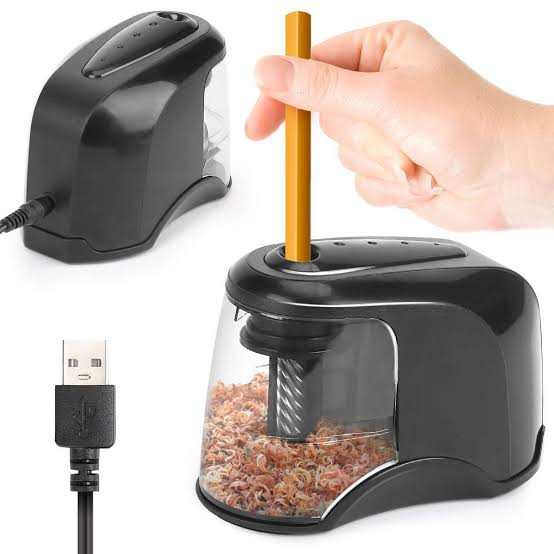
When a pencil is inserted into the sharpening opening, it presses against an actuator positioned near the opening. Once the actuator reaches the actuation point, the state of the subminiature micro switch toggles. The control board detects this change in electrical signal and triggers the motor to start.
When the user removes the pencil, a return spring pushes the actuator back to its initial position, causing the switch to revert to its original state and the motor to stop. This design simplifies the process, makes operation more intuitive, and helps reduce both the overall size and the cost of the device.
Auto-Stop When Sharpening Is Complete
As the sharpening process progresses, the pencil is gradually fed further into the blade assembly. Upon reaching a preset position—or when a specific mechanical travel limit is triggered—the switch is actuated, sending a "completion" signal to the control board, which then cuts power to the motor.
This method of position-based detection is more reliable than relying on a timer. Because the hardness of the wood and the diameter of the pencil lead vary between manufacturers, the actual time required for sharpening differs; only by detecting that the pencil has reached the correct "sharpened" position can the device trigger the stop action accurately.
Safety Interlock for the Shavings Bin or Cover
By incorporating a switch in this area, the circuit remains open—preventing the motor from operating—unless the shavings bin is correctly seated and the top cover is securely closed. If the shavings bin is removed, the switch immediately disconnects the circuit, preventing the motor from starting (or stopping it if it's already running). This prevents wood shavings and graphite particles from scattering and protects the user’s hands from coming into contact with the high-speed rotating blade assembly.
Key Advantages of Subminiature Micro Switches for Pencil Sharpeners
Compact Size for Tight Enclosures
Subminiature micro switches feature a highly compact design. Their small footprint allows them to be installed directly near the pencil-insertion opening or the internal mechanism of an electric pencil sharpener—areas where space is often limited. This proximity shortens the distance between the actuator and the component being detected, reduces the need for additional structural parts, and simplifies the overall design.
Precise and Repeatable Switching Action
The actuation point of a subminiature micro switch is determined by its internal geometry, ensuring excellent consistency. This makes it easier to align the switching position with the actual mechanical travel, eliminating the need for repeated adjustments or compensation. Furthermore, the built-in "snap-action" mechanism prevents contact chatter or ambiguous switching states—issues that can occur with slower, gradual contact—thereby ensuring reliable signal transmission and minimizing the risk of operational errors.
Reliable Performance Under Repeated Use
In home and office environments, electric pencil sharpeners undergo frequent start-stop cycles and mechanical state changes. Consequently, the reliability of a switch depends on its ability to remain stable over long periods of repeated operation. When evaluating the service life, one must consider factors such as electrical load, actuation frequency, operating force, and the actual operating environment. It is not enough to look solely at mechanical lifespan; one must also account for any discrepancies between test conditions and real-world usage.
Conclusion
In an electric pencil sharpener, a subminiature micro switch acts as an interface between the mechanical components and the electronic control system. It converts physical states—such as the insertion of a pencil, the completion of the sharpening process, or the secure closure of the shavings receptacle—into clear electrical signals. These signals are then processed by the control board to facilitate core functions: automatic startup, automatic shutdown, and safety interlocks. Thanks to these switches, pencil sharpeners can offer a seamless user experience—starting automatically upon pencil insertion, stopping once sharpening is complete, and remaining inactive if the unit is not properly assembled—ensuring both ease of use and operational safety.
When selecting a switch, it is essential to comprehensively evaluate electrical parameters, contact logic, operating force and travel, actuator type, environmental adaptability, and mechanical lifespan. It is advisable to prioritize micro switch suppliers known for stable quality control and consistent product specifications. Only by ensuring the subminiature micro switch is precisely matched to the pencil sharpener’s mechanism can it maintain stable, repeatable detection performance—even under conditions of long-term, high-frequency use and exposure to significant amounts of pencil shavings.
The Importance of Basic Micro switches in Semiconductor Testing Equipment
Related Article