Why Use a Subminiature Micro Switch in Commercial Snow Melt Machines?
Commercial snow-melting machines require the coordinated operation of multiple mechanical components during startup, running, and shutdown phases. The equipment's control system must not only drive functional components—such as motors and heating elements—but also monitor the real-time status of parts like covers, levers, or other movable mechanisms. Consequently, mechanical actions must be converted into electrical signals for transmission to the control circuit.
The subminiature micro switch is a crucial component for this conversion. It transforms mechanical positions or user actions into electrical signals, providing position detection and operational status feedback. This article analyzes how the switch serves as a signal interface between mechanical inputs and electrical control systems, offering a deeper understanding of this electronic component.
What Is a Subminiature Micro Switch?
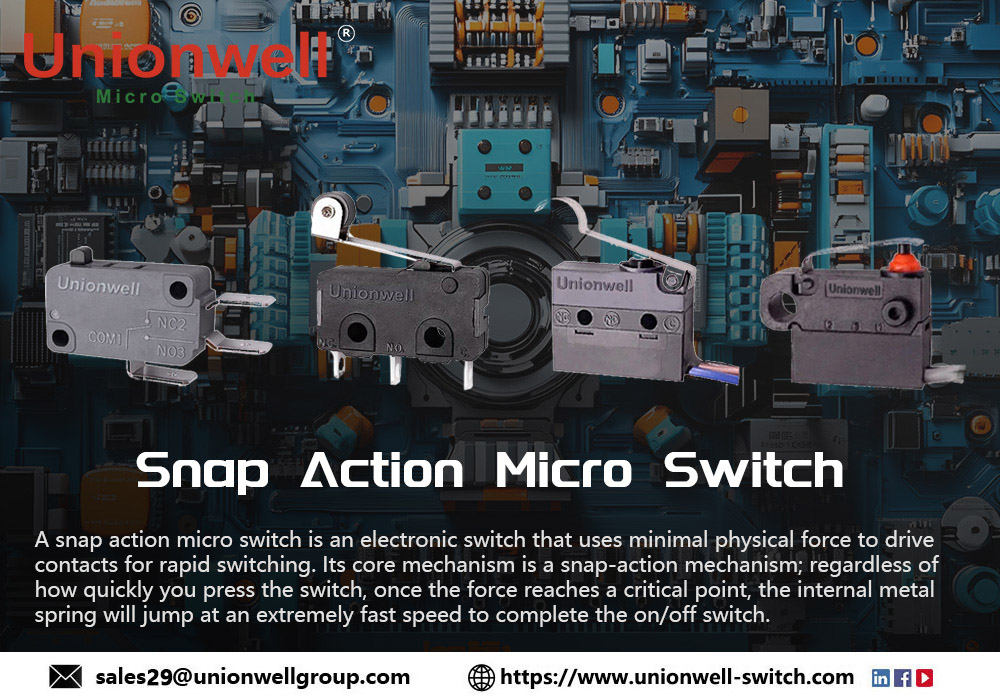
A subminiature micro switch is a snap action mechanical component. Mechanical action pushes the actuator, causing the internal contact mechanism to switch rapidly at a specific position, thereby altering the state of the electrical circuit. In commercial snow-melting machines, these switches are reliably mounted near target mechanical components, enabling mechanical-to-electrical conversion within compact spaces.
The operational sequence is: Mechanical Movement → Actuator → Contact Switching → Electrical Signal → Control Circuit. When a mechanical component reaches a designated position, the switch's output state changes, allowing the control circuit to determine whether the mechanism has completed its action.
How Does a Subminiature Micro Switch Transmit Signals?
Signal transmission in a subminiature micro switch is primarily handled by the actuator, snap-action mechanism, contact mechanism, and terminals. A common SPDT (Single-Pole Double-Throw) configuration includes COM (Common), NO (Normally Open), and NC (Normally Closed) terminals.
As mechanical components move, external structures—such as covers or levers—push the actuator. Upon reaching the operating position, the snap-action mechanism drives the moving contact to switch rapidly. This changes the connection status between the COM terminal and either the NO or NC terminal, generating an electrical signal.
The control circuit determines whether the mechanical component is in position based on the open/closed state. This signal is transmitted to the control board, where the controller executes the corresponding logic. In essence, the subminiature micro switch provides a reliable electrical interface, converting mechanical positions and movements into switching states that the electronic system can recognize.
What Does a Subminiature Micro Switch Do in a Commercial Snow Melt Machine?
Subminiature Micro Switch for Position Detection
Position detection is a primary application for subminiature micro switches. In commercial snow melt machines, mechanical components—such as covers or levers—must reach specific positions during startup, operation, or shutdown.
Once the mechanical mechanism reaches the target position, it actuates the switch, causing the micro switch to change its contact state and output a signal to the control circuit, allowing the controller to determine the mechanism's status. However, the micro switch provides only the position signal; the final logic is determined by a combination of the control system, mechanical design, and other safety measures.

Subminiature Micro Switch for Signal Transmission
Another function of the subminiature micro switch is signal transmission. When the mechanical mechanism undergoes displacement, the switch converts this movement into an electrical signal via contact switching and transmits it to the control circuit, establishing a signal chain: Mechanical Input → Micro Switch → Electrical Signal → Control Circuit.
For commercial snow melt machines, signal stability is crucial. The switch must maintain consistent actuation positioning and contact behavior during repeated operations, and the appropriate contact material must be selected based on the signal load to ensure the control circuit receives a stable, reliable input signal.
Subminiature Micro Switch for Operation Status Feedback
In addition to position detection, subminiature micro switches provide operation status feedback. When the equipment starts, stops, or a mechanical mechanism moves, the control circuit can determine component status based on different contact states. The controller simply uses the discrete signal to ascertain whether the mechanism has reached the designated actuation point.
For ON/OFF detection, this method offers a straightforward structure, manageable costs, and simple interfacing. However, if the system requires continuous position data, other sensing technologies should be employed; a micro switch cannot serve as a continuous position sensor.
Why Is a Subminiature Micro Switch Suitable for Commercial Snow Melt Machines?
Compact Size for Limited Internal Space
Commercial snow melt machines must house motors, heating components, control boards, wiring, and mechanical structures within their interiors; compact designs often limit the space available for switch installation.
Subminiature micro switches, however, are small in size. They can be installed close to the detection mechanism, shortening the mechanical interface between the actuator and the component being monitored, while also reducing the need for additional structural components. Of course, size is not the only criterion; the choice should also take into account the actuator type and connection method.
Fast and Defined Switching Action
Subminiature micro switches utilize a snap-action mechanism. This allows the snow melt machine to achieve a more precise switching point, thereby enhancing switching consistency. For equipment manufacturers, this helps engineers align switch movement with the actual mechanical stroke.
Reliable Switching for Repeated Operation
Commercial snow melt machines see frequent use, with a single operating cycle involving multiple starts, stops, and changes in mechanical state. Consequently, the reliability of the micro switch depends not only on initial switching performance but also on its ability to withstand long-term, repeated operation.
Actual service life must be evaluated by considering signal load, switching frequency, actuation force, and operating conditions. When selecting a subminiature micro switch, one should not look solely at the rated number of cycles but also verify whether the test conditions closely mirror the actual application.
Subminiature Micro Switches in Home Appliances
Some snow melt machines are designed for home use, allowing users to prepare treats themselves. The structure, operation, and control requirements for these devices differ from commercial models. In this context, the subminiature micro switch—functioning as a home appliance micro switch—prioritizes compact design, ease of operation, stable feedback signals, and long-term reliability.
Subminiature Micro Switches for Household Snow Melt Machines
In household snow melt machines, subminiature micro switches can be installed near mechanical components such as triggers or buttons. When a user operates the device, mechanical movement actuates the switch, changing its contact state. A signal is then transmitted via PCB or wiring to the control circuit. Thus, the switch serves as the interface between physical operation and the electronic control system, handling signal transmission rather than direct control of the entire machine.
Why Signal Reliability Matters in Home Appliances
Since users operate the device via buttons, lids, or other mechanical structures, the reliability of the switch signal determines whether the control system correctly registers the user's input. Regarding ON/OFF feedback, the micro switch should switch reliably at the intended mechanical position, ensuring that tolerances or trigger deformation do not alter the switching point.

How to Choose the Right Subminiature Micro Switch for a Commercial Snow Melt Machine?
Define Signal Transmission Requirements
If the subminiature micro switch is used solely to detect the position of mechanical components, select a configuration suitable for ON/OFF position detection; if it needs to identify various mechanical states, choose a contact configuration based on the required circuit logic. Additionally, determine whether it is used for low-energy signal input or for directly switching an electrical load, ensuring that the contact material, electrical rating, and switching capability are compatible.
Match the Mechanical Structure
After confirming the installation space, analyze the trigger movement, actuation position, operating force, and travel. For linear motion with direct actuation, consider a pin plunger; if there are angular changes or direct contact is not possible, consider a lever or roller lever. Also, match the operating force to avoid false triggering caused by excessive load or insufficient pre-pressure, and ensure sufficient over-travel after switching to prevent continuous stress.
Match the Electrical Circuit
Determine electrical specifications based on actual circuit conditions, including voltage, current, contact configuration, and signal type. If providing only a low-current signal, select the contact system based on the actual signal load; if handling a larger electrical load, evaluate rated current, load type, switching frequency, and contact material. Therefore, it is best to provide complete circuit details before procurement.
Evaluate the Operating Environment
The operating environment of a commercial snow melt machine may involve temperature fluctuations, moisture, dust, vibration, and mechanical shock. In specialized environments like kitchens, select products with appropriate protection (such as waterproof micro switches with an IP67 rating). However, the protection rating must be evaluated in conjunction with the installation structure; sealing, wire termination, connectors, and the equipment enclosure all affect the final level of environmental protection.
Evaluate Service Life
Estimate the number of switching cycles over the product's lifecycle and compare this with the switch's mechanical and electrical life ratings. If the switch primarily transmits signals, focus on contact reliability and repeated actuation; if it directly switches electrical loads, evaluate load type, current, voltage, and switching frequency.
Conclusion
In a commercial snow melt machine, the subminiature micro switch serves as a signal transmission interface, converting mechanical movement and operational status into electrical signals that are then transmitted to the control circuit. Its compact size makes it suitable for limited internal space, while the snap-action mechanism provides a precise switching point.
Therefore, when selecting a model, one should not focus solely on the dimensions provided by the micro switch manufacturer; instead, a comprehensive evaluation of operating force, actuation position, travel, electrical rating, contact configuration, mechanical life, actuator type, terminal type, and operating environment is required. Only when the microswitch is correctly matched to the product can stable signal transmission, reliable operational feedback, and long-term switching performance be achieved.
Why Is a Sealed Subminiature Micro Switch Used for Smart Toilet Seat Detection?
How Does a Miniature Micro Switch Detect Lid Locking in a Coffee Machine?
Related Article