The Importance of Using Miniature Micro Switches in Pedestrian Crossing Buttons
The pedestrian push button at a street corner is an inconspicuous piece of roadside equipment. A pedestrian presses it, hears a "click," sees an indicator light turn on, and then waits for the next crossing phase. For traffic engineers, however, the focus is on something else: every single press must be translated into a reliable request signal for the traffic controller. This task is handled by a miniature micro switch housed within the button.
Despite its small size, the miniature micro switch plays a critical role: it determines whether a request has been registered, confirms that the button has returned to its resting position, and monitors the integrity of the circuit. A failure can have serious consequences—pedestrians may grow impatient and cross against the light, visually impaired individuals may lose their only form of operational feedback, or a damaged circuit could render the entire button inoperable. This article explores the function of these switches within pedestrian push buttons and explains why "snap action" is essential for signal reliability, providing a deeper understanding of this electronic component.
What a Miniature Micro Switch Does Inside a Push Button
Here is how it works: when a pedestrian presses the button, the internal mechanism transmits the force to the switch’s actuator. Within a very short travel distance, an internal spring mechanism reaches a critical threshold, causing the electrical contacts to switch state instantaneously—a process known as "snap action," which is also the source of the audible "click." At this point, a request signal is sent to the traffic signal controller, the indicator light illuminates, and the request is processed during the next available crossing phase.

In this sequence, the miniature micro switch performs three simultaneous functions:
1. Registration: It converts a mechanical press into a definitive electrical signal.
2. Feedback: The "click" sound and the sudden change in resistance provide the user with both auditory and tactile confirmation.
3. Reset Confirmation: Once the button is released, the internal spring returns to its original position, restoring the signal to its default state; this informs the controller that the button is ready for the next user.
It is worth noting that pedestrian push buttons are among the most frequently operated pieces of public infrastructure. At a busy intersection, a single button might be pressed 200 to 500 times a day—often subjected to repeated, rapid-fire pressing by children or impatient pedestrians. This dictates that it must be selected according to industrial component standards—with a mechanical lifespan designed for at least one million cycles, placing it in the same durability class as the power tool micro switches.
Why Snap Action and SPDT Contacts Determine Signal Quality
The value of "snap action" lies not just in speed, but in certainty. It decouples the "trigger" event from the speed at which the button is pressed; once a critical threshold is crossed, the internal spring mechanism switches state at a consistent position and speed, regardless of whether the user presses the button quickly or slowly. For the controller, this ensures a clean signal edge and a consistent threshold, making debouncing simple and reliable while eliminating the ambiguous states that could arise from a "partial" or hesitant press.
An SPDT (Single-Pole, Double-Throw) micro switch is typically chosen to enable circuit monitoring. By providing both normally open (NO) and normally closed (NC) outputs, it allows the controller to distinguish between a standard button press and fault conditions, such as an open circuit or a short circuit. Without this switching mechanism, a controller might be unable to differentiate between an idle button and a severed wire—meaning that if a button is damaged or a cable is accidentally cut during construction, the system might fail to detect the fault.
Furthermore, if the contacts become stuck (welded) together, they might continuously send an active signal, disrupting pedestrian traffic control. By cross-referencing the two output states of an SPDT micro switch, the controller can identify abnormal contact behavior and determine whether the button has failed, thereby enhancing the system's fault-detection capabilities and operational reliability.
The Outdoor Environment Is the Real Test
Pedestrian push buttons are installed on curbsides and signal poles, leaving them exposed to the elements year-round. In the summer, the surface temperature of a signal pole can exceed 70°C under intense sunlight, while in the winter, it may drop below -20°C. High temperatures can cause stress relaxation in the spring mechanism and drift in the operating force, while low temperatures can cause lubricants to thicken, leading to sluggish operation. Consequently, these miniature micro switches must be capable of operating across a wide temperature range to accommodate seasonal fluctuations.
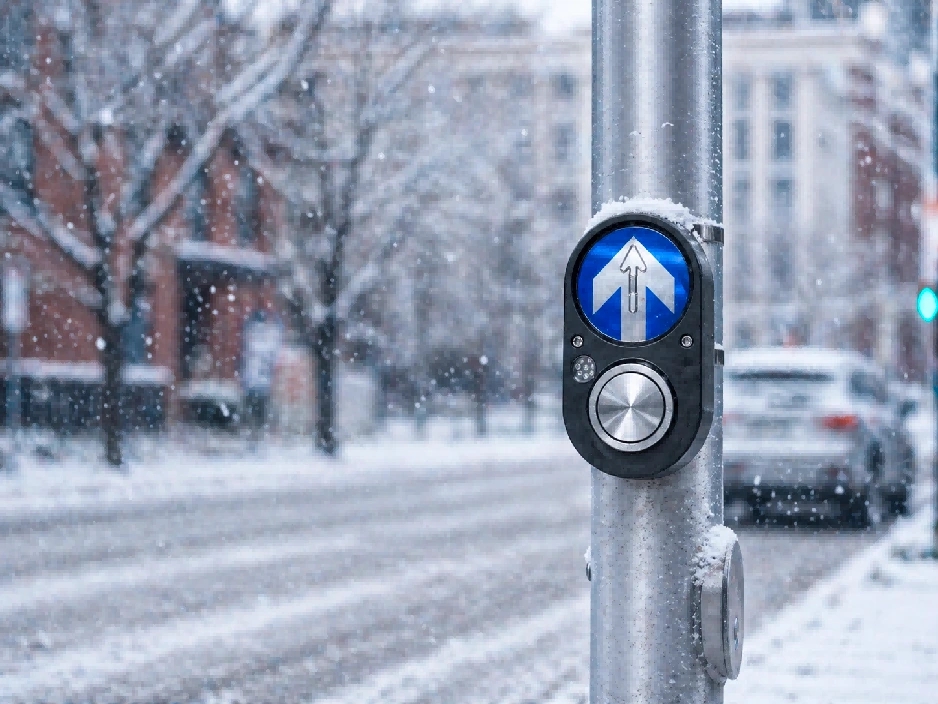
For applications involving signal-level switching and high-frequency use, mechanical lifespan and the stability of the operating force are critical; a mechanical lifespan of at least 1 million cycles is a key specification to consider during selection. Additionally, these buttons must be robust enough to withstand physical abuse, such as kicking, impacts, or attempts to pry them open. During the design process, the button housing and the force-transmission mechanism should absorb impacts and limit the force applied to the switch, thereby preventing damage to the internal spring element caused by accidental overloads. The body of the micro switch itself should not be relied upon as the primary line of defense against impact.
The Parameters to Check Before Specifying
Translating these requirements into a specification sheet yields the following checklist:
|
Parameter |
Typical Range |
Field Symptoms of Incorrect Selection |
|---|---|---|
|
Operating Force (OF) |
100–300 gf |
Too light: prone to accidental triggering; too heavy: elderly or children may find it difficult to press |
|
Pretravel (PT) |
0.3–0.8 mm |
Too large: the button feels loose and spongy |
|
Movement Differential (MD) |
<0.15mm |
Too large: signal threshold drift |
|
Contact Structure |
SPDT |
Single SPST fails to detect silent line failures |
|
Contact Resistance |
Initial <100mΩ |
Intermittent response when pressed due to terminal oxidation |
|
Insulation / Dielectric Strength |
>100Ω; Terminal-to-Case: 1500 VAC |
False signals during humid seasons |
|
Mechanical Life |
1,000,000 cycles |
Operating force drift, tactile degradation |
|
Temperature |
-25 to +125°C |
High-temperature drift, low-temperature hysteresis |
How to Choose the Micro Switch
1. Determine contact specifications: Clarify whether the output connects to a controller’s input/sensing circuit or a load-bearing circuit. Do not be misled by the assumption that "higher current capacity is always better."
2. Define tactile feel: Calculate the required actuation force and travel distance, keeping in mind the needs of the target user demographic (including those with disabilities).
3. Specify service life: Estimate the expected number of actuations in the field and prioritize mechanical lifespan as the primary metric.
4. Consider the environment: Evaluate temperature, humidity, terminal type, and wire harness stress. Often, the terminals—rather than the switch body itself—are the first point of failure in environments prone to condensation.
Pedestrian push-buttons are typically installed for a decade, often purchased in batches of thousands. If the actuation point varies significantly between batches, the tactile feel will differ, leading to an increase in user complaints.
FAQ
Q1: If a pedestrian holds the button down, will the controller keep receiving requests?
A1: No. The button signal is treated as a state; once the controller registers a request, it enters its internal logic processing phase. Repeated or sustained pressing does not result in cumulative requests. The real concern is contact welding (sticking), which could cause the controller to trigger a pedestrian phase when no one is actually present.
Q2: If there is no response after pressing the button, is the switch necessarily the problem?
A2: Not necessarily. 1. The controller only processes requests during the next available pedestrian phase; expecting the signal to change the light immediately is a misunderstanding of the system logic. 2. Issues such as contact oxidation, loose terminals, or a jammed button mechanism can cause intermittent operation.
Q3: Why is an SPDT micro switch required?
A3: A simple "normally open" (NO) switch cannot distinguish between "no one has pressed the button" and "the circuit is broken." An SPDT switch includes a "normally closed" (NC) path, allowing the controller to continuously monitor circuit integrity. If a wire breaks, it is detected immediately, enabling municipal maintenance teams to shift from a reactive "repair-upon-complaint" model to a proactive "detect-and-fix" approach.
Q4: How many years of actual service can a switch with a 1-million-cycle mechanical lifespan provide?
A4: Theoretically, assuming 200–300 actuations per day—totaling approximately 70,000 to 110,000 cycles per year—such a switch could last for nine to thirteen years or more.
Q5: How do destructive actions—such as kicking or smashing—affect a switch, and how can this be mitigated?
A5: The design strategy relies on the enclosure to absorb energy, while the switch itself is engineered for fault tolerance. It is crucial to avoid switches with insufficient over-travel; otherwise, repeated, forceful (or malicious) pressing can cause the internal spring mechanism to undergo premature plastic deformation, leading to a shift in the required actuation force.
Conclusion
The importance of a miniature micro switch in a pedestrian crossing button lies in its ability to transform a physical press into a reliable, monitorable, and verifiable signal. Its momentary-action mechanism provides a consistent trigger edge, while an SPDT (Single-Pole, Double-Throw) configuration enables system self-diagnostics. Furthermore, a mechanical lifespan of one million cycles is more than sufficient to withstand even the roughest treatment in a public urban environment. Taken together, these elements define the full engineering significance behind that familiar "click."
For manufacturers of traffic equipment, the priority in component selection is to find a micro switch supplier that offers consistent batch quality, clear and precise specifications, and full transparency—providing detailed force-to-travel curves and batch-specific performance data. When a pedestrian button is pressed hundreds of times a day, any drift in the switch’s actuation point becomes something the entire city can feel.
What Are the Top 5 Types of Automotive Micro switches Used in New Energy Vehicles?
Related Article