
Analysis of Polar Magnetic Keyboard Switches: Structure, Function, and Characteristics
In recent years, keyboard technology development has shown two trends: on the one hand, users' performance requirements for input devices are constantly increasing, with a growing focus on response speed, trigger accuracy, and consistency; on the other hand, keyboards are transforming from simple input tools into highly customizable and calibrable precision electronic systems.
Against this backdrop, keyboard switches are upgrading from "mechanical triggering" to "non-contact sensing," and polar magnetic keyboard switches are gradually becoming an important choice for high-end magnetic switch keyboards. This article will focus on polar magnetic keyboard switches, providing a systematic analysis from three levels: structure, function, and performance characteristics, to help readers deeply understand their technical principles and practical application value.
What Is a Polar Magnetic Keyboard Switch?
A polar magnetic keyboard switch is a keyboard switch that operates based on the principle of magnetic induction. It uses a magnet with a defined polarity arranged inside the switch, combined with a Hall sensor located on the PCB board, to continuously output a stable and resolvable electrical signal during key travel.
The meaning of "Polar" in the magnetic switch structure lies in the directional control of the magnet's polarity. Unlike other switches that focus solely on changes in magnetic flux, the polar magnetic keyboard switch emphasizes the relative relationship between the magnetic pole direction and the PCB sensor, thereby improving signal linearity and consistency.
Within the entire keyboard, the polar magnetic keyboard switch is no longer just an "on or off" switch, but a sensing unit capable of continuously outputting different travel information. This positioning makes it the foundational hardware for implementing Rapid Trigger and custom travel.
Structural Design of a Polar Magnetic Keyboard Switch
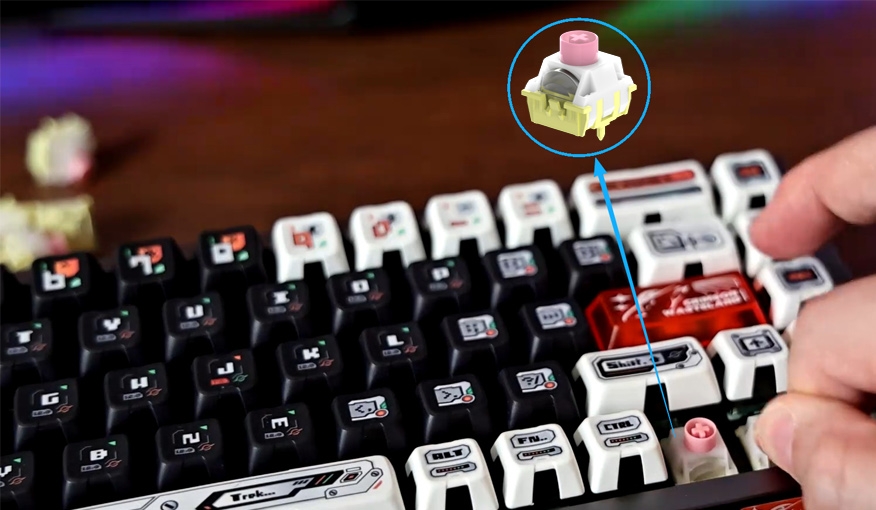
Structurally, a polar magnetic keyboard switch typically consists of core components such as a top cover, switch stem, N52 magnet, spring, light guide post, and base. Each component directly affects the switch's feel, stability, and signal consistency.
- The top cover is primarily responsible for guiding the switch stem and providing dust protection; it ensures the vertical stability of the switch stem.
- The switch stem is the direct transmission component for the user's tactile feedback, determining the overall smoothness of the keystrokes.
- The N52 magnet is typically installed at the bottom of the switch stem or within a specific cavity and is a key functional component of the polar magnetic keyboard switch. It can provide a sufficiently strong and stable magnetic field variation range within a limited space, providing the basic conditions for high-precision switch detection;
- The spring is responsible for providing the rebound force, and its elasticity curve affects the key feel and reset speed;
- The light guide column is mainly responsible for the RGB lighting effect;
- The base integrates the sensor mounting position and circuit connection interface, serving as the "channel" between the switch and the keyboard.

Among these components, the position and function of the magnet are particularly critical. The change in distance between the magnet and the PCB sensor determines the change curve of the magnetic field strength, thus affecting the linearity of the entire magnetic switch signal and the adjustable range of the trigger travel. The polar magnetic keyboard switch, through a reasonable guide surface design, reduces switch wobble, ensuring that the magnetic field change and travel change are highly consistent, allowing users to input more accurately and comfortably.
How a Polar Magnetic Keyboard Switch Works
The basic working principle of a polar magnetic keyboard switch is based on the change in magnetic field caused by the change in the position of the magnet during key press. A sensor on the PCB board converts this change into an electrical signal. When the user presses a keycap, the switch moves the magnet vertically. The distance between the magnet and the Hall sensor changes, and the sensor detects the difference in magnetic field strength or direction, outputting a corresponding analog voltage signal.
Therefore, there is a clear physical correspondence between the key travel change and the magnetic field change. Through a reasonable magnet polarity design and structural layout, a more linear signal curve can be obtained, providing a stable foundation for subsequent digital processing.
The analog-to-digital signal conversion logic is usually completed in the keyboard's main control chip. The ADC converts the analog signal into a digital quantity, and then an algorithm determines whether a set trigger threshold has been reached. Because there is no physical contact between metal contacts throughout the process, the contactless structure significantly improves signal stability. There are no issues with contact bounce, arcing, or oxidation, resulting in more consistent signal characteristics over long-term use.
Actuation Principle of a Polar Magnetic Keyboard Switch
The detection mechanism of polar magnetic field changes is the core technology of the polar magnetic keyboard switch. By detecting changes in magnetic pole direction or magnetic flux density, the sensor can accurately sense the axis position.
The adjustable trigger travel relies on a software-level redefinition of the magnetic field signal threshold. Users or manufacturers can set different trigger points according to their needs without changing the physical structure. The independent control principle of the trigger and reset points enables rapid triggering and rapid reset. This feature has significant advantages in high-frequency input and e-sports scenarios.
Key Functions of a Polar Magnetic Keyboard Switch
The most basic function of a polar magnetic keyboard switch is to convert user keystrokes into keyboard input signals. However, unlike mechanical switches, polar magnetic keyboard switches provide continuously resolvable travel information.
Its adjustable actuation travel feature allows the same keyboard to adapt to various user needs. Light actuation is suitable for high-speed input, while deep actuation is better suited for scenarios requiring protection against accidental keystrokes (such as office work).
Its non-contact sensing structure also allows for rapid signal changes without mechanical lag, resulting in more immediate key response. In high-speed input scenarios, polar magnetic keyboard switches offer lower latency and higher input consistency, reducing performance fluctuations caused by differences in switch types.
Performance Characteristics of Polar Magnetic Keyboard Switches
- In terms of response speed, polar magnetic keyboard switches, because they do not require waiting for contact closure, theoretically have a shorter actuation path and faster signal response.
- In terms of accuracy, an RT of 0.001 means the switch can detect extremely subtle changes in travel. This precision provides the hardware foundation for high-end input algorithms.
- A lifespan of 100 million keystrokes is a typical advantage of the magnetic switch structure. Since there is no metal contact wear, performance degradation primarily depends on the stability of the mechanical structure.
Why Polar Magnetic Keyboard Switch Offers Higher Durability
Compared to mechanical keyboard switches, its contact triggering mechanism is vastly different. Mechanical switches rely on the closure of metal contacts to generate discrete signals, while polar magnetic keyboard switches achieve non-contact detection through changes in the magnetic field. This difference not only changes the signal generation method but also directly affects lifespan, accuracy, and adjust-ability.
The absence of metal contact wear and the structural advantages of the separate ball-and-socket joint allow the switch to maintain stable feel and signal characteristics over long-term use, avoiding common contact aging problems and significantly increasing the switch's lifespan and performance consistency.
Applications of Polar Magnetic Keyboard Switch
In high-end magnetic keyboards, the polar magnetic keyboard switch has become a key performance selling point, especially suitable for products emphasizing responsiveness and adjustability. The demand for fast actuation and adjustable travel in gaming keyboards makes magnetic switch solutions more attractive, adaptable to different game genres.
In custom keyboards and professional input devices, users prioritize switch consistency and programmability, a need perfectly met by the polar magnetic keyboard switch. Different user groups have different priorities regarding magnetic switch characteristics, driving diverse designs in switch structure and parameters, resulting in more choices on the market.
Conclusion
Overall, the polar magnetic keyboard switch, through its well-defined structural design, high-precision magnetic induction principle, and non-contact signal generation method, constructs a completely new keyboard input solution. Its advantages in working principle and functionality enable it to achieve advanced features that are difficult to achieve with mechanical switches.
With the continued development of keyboard technology, the application potential of the polar magnetic keyboard switch in future high-end input devices is promising. From the perspective of micro switch manufacturers, high-quality structural design, magnet control, and sensor matching are key factors in determining the performance ceiling of a polar magnetic keyboard switch.
The Importance of Using a Waterproof Miniature Micro Switch in Modern Devices
What You Need to Know About Car Seat Adjustment Switches and Its Functions
Related Article