How Does a Miniature Micro Switch Detect Lid Locking in a Coffee Machine?
An automatic coffee machine involves multiple mechanical and electronic control steps, from adding coffee ingredients and closing the brewing chamber lid to locking the lid and starting the brewing process. Before initiating the brewing program, the control system needs to confirm that the brewing chamber lid is correctly closed and locked; otherwise, it cannot proceed to the next stage of the workflow.
This is one of the key applications of a miniature micro switch in coffee machines. It is typically installed near the brewing chamber lid or locking mechanism. By detecting changes in the position of the lid, latch, or related mechanical components, it converts the mechanical state into an electrical signal and feeds it back to the control system. Simply put, it tells the control system "whether the lid is in place," and the control system then uses this signal to decide whether to allow the coffee machine to start.
What is a Miniature Micro Switch for Coffee Machine Lid Detection?
What is the Miniature Micro Switch?
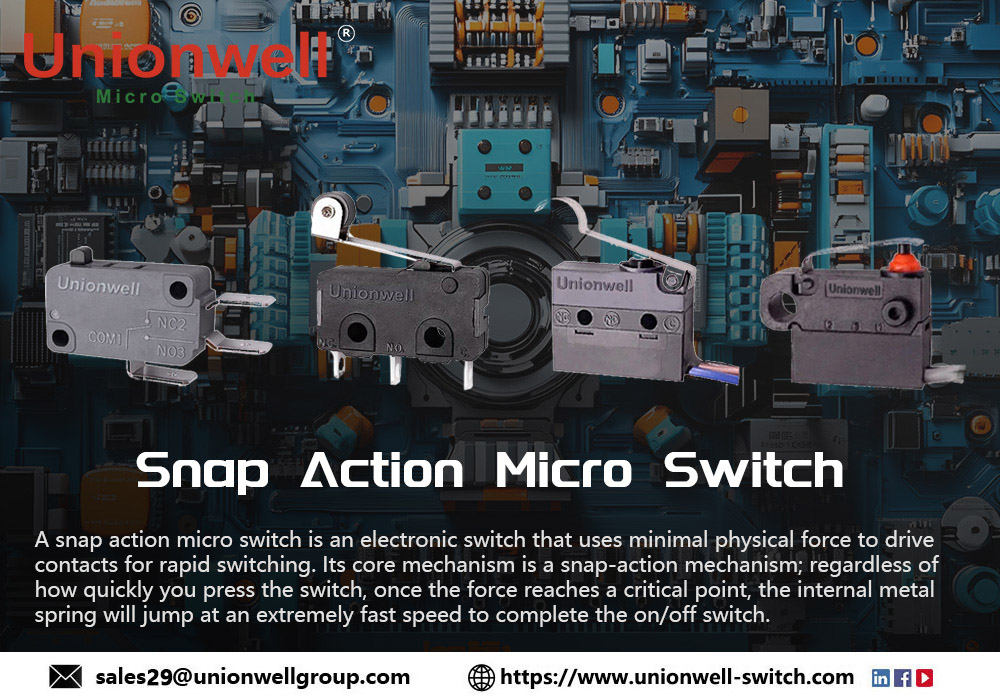
A miniature micro switch is a switching element that achieves rapid contact switching through mechanical action. It consists of an actuator, a snap action mechanism, a contact, a housing, and terminals. The actuator receives external mechanical force; the snap action mechanism drives the rapid switching of internal contacts; the contact completes the circuit's connection or disconnection; the housing provides support for the internal structure; and the terminals connect to the external control circuitry.

The Role of a Miniature Micro Switch in Coffee Machine Lid Detection
In a coffee machine, the miniature micro switch primarily performs mechanical position detection. It detects whether the brewing chamber lid, latch, or related mechanical structure has moved to the designated position. When the lid is closed and the latch is in its final locked position, the micro switch actuator can be pushed by a push rod or other mechanical structure. When the actuator is pressed to the designated position, the contact state changes, and the control system can determine whether the lid meets the set conditions based on this signal.
Why Use a Miniature Micro Switch for Lid Locking Detection?
The internal space of a coffee machine is limited, requiring the simultaneous placement of the brewing components, drive mechanism, heating element, and control PCB; therefore, the size of the status detection component should not be too large. Miniature micro switches are small in size and can be installed near the cover or latch, interacting with mechanical structures through different actuators.
Furthermore, micro switches provide clear contact states, making them suitable for detecting discrete mechanical states such as "open/closed" and "unlocked/locked." For coffee machines, they can directly utilize existing mechanical movements to complete state detection, reducing the need for other complex mechanisms.
How Does a Miniature Micro Switch Detect Lid Locking?
Lid Closing Moves the Miniature Micro Switch Actuator
When the user closes the brewing chamber lid, the lid moves along a designed trajectory. A rotating mechanism's latch may lock as the lid approaches the closed position, while a sliding mechanism locks via linear motion.
The Miniature Micro Switch can be installed at a critical position in the locking mechanism. Other mechanical structures drive the Actuator, converting mechanical displacement into an electrical state. The latch can directly push the pin plunger or change the direction of movement via a lever. Therefore, the design must match the final locking position, the Actuator trigger position, and the relationship between their movements to ensure the Micro Switch completes its action at the correct stage.
Actuator Movement Changes the Contact State
When the Actuator is pushed to the specified operating position, the Snap Action Mechanism drives the internal Moving Contact to switch rapidly, changing the circuit state. Taking the SPDT Miniature Micro Switch as an example, the conduction relationship between COM, NO, and NC changes with contact movement, allowing the control circuit to identify whether locking is possible. To avoid ambiguous electrical states during slow movement.
The Miniature Micro Switch Sends a Lid Status Signal
After contact switching, the Miniature Micro Switch transmits the status signal to the coffee machine's control circuit via terminals. The control board then determines whether the brewing chamber lid is correctly locked. The complete detection process is: Lid Closing → Locking Mechanism → Actuator → Contact Switching → Electrical Signal → Controller.
However, the Micro Switch is only responsible for outputting the electrical signal corresponding to the mechanical state; the actual locking determination is completed jointly by the mechanical structure, circuit connections, and control program.

How Does Lid Lock Detection Work as a Safety Interlock?
Brewing Starts Only After Lid Lock Confirmation
In coffee machines, lid detection can be a condition for starting the brewing program. The logic can be expressed as:
- Lid Open → Brewing Not Allowed
- Lid Closed but Not Locked → Brewing Not Allowed
- Lid Locked → Condition Satisfied → Brewing Allowed
The miniature micro switch connects the mechanical locking structure to the electronic control system, allowing the lid's state to participate in the machine's safety interlock.
What Happens When the Lid Is Not Properly Locked?
If the lid is not fully closed, the latch is not in place, or the mechanical structure does not move sufficiently, the actuator may not reach the specified operating position, preventing the micro switch from entering the state required by the control system.
For example, even if the lid covers the brewing chamber, if the latch is not fully engaged, and the micro switch's actuator is not sufficiently pushed, the control system may maintain a brewing-prohibited state. If the installation position is too early, it may trigger prematurely before the cover is fully locked. Therefore, the key to cover detection is whether the Micro Switch trigger position truly corresponds to the cover's safe locking position.
Key Considerations When Selecting a Miniature Micro Switch for Coffee Machine Lid Detection
Actuation Position and Operating Force
Actuation Position determines at which stage of the lid movement the micro switch completes the contact switching and should match the final position of the latch. Too early an actuation position may generate a detection signal before the lid is fully locked; too late, additional mechanical travel is required for triggering.
Simultaneously, the Operating Force must match the mechanical force provided by the latch mechanism. Too high a force will increase the resistance to lid closure; too low a force requires assessing the risk of false triggering due to vibration and assembly deviations. Therefore, when selecting a switch, the Operating Force, Actuation Position, and latch mechanical output should be comprehensively matched to ensure the switch operates stably in the correct position.
Actuator Type and Mechanical Tolerance
Different coffee machines have different lid movement methods, so the actuator needs to be selected based on the actual structure. If the latch pushes the switch axially, a pin plunger can be considered; if there is rotational motion or a large range of motion, a lever actuator or similar structure can be used. In other words, it's necessary to verify whether reliable triggering can be maintained throughout the entire range: Mechanical Tolerance → Actuator Travel → Actuation Position → Final Lock Position.
Contact Configuration and Mechanical Life
Common miniature micro switches offer various contact types, and engineers need to select the appropriate configuration based on the control board. Furthermore, the actual load of a micro switch is completely different from the overall power of the coffee machine; therefore, the selection should be based on the actual voltage, current, and switching condition the micro switch is handling.
Mechanical life relates to long-term reliability. The coffee machine's brewing chamber lid opens and closes repeatedly, and each opening and closing may generate one or more switch actuations. Therefore, the required mechanical life should be calculated based on the expected number of uses, with a reasonable margin.
Conclusion
In a coffee machine, the miniature micro switch detects the mechanical position of the brewing chamber lid or locking mechanism, converting "whether the lid is properly closed and locked" into an electrical signal, which is then fed back to the control system. The true determinant of a micro switch's reliability lies in the compatibility between its operating force, actuator position, mechanical tolerance, and mechanical life parameters and the coffee machine's mechanical structure and control circuitry.
For coffee machine manufacturers, selecting a suitable miniature micro switch can effectively reduce instability issues such as false triggering and insufficient triggering. Professional micro switch manufacturers can tailor the actuator, triggering parameters, contact configuration, and mechanical lifespan to the specific lid structure, locking method, and circuit requirements of the coffee machine, thereby helping manufacturers develop more reliable solutions.
Why Use a Subminiature Micro Switch in Commercial Snow Melt Machines?
What Is the Future Development of Snap Action Micro Switch?
Related Article