
How Does Automotive Micro Switch Improve Your Car?
With the rapid advancement of automotive electronics technology, modern vehicles are progressively shifting toward highly integrated electronic control systems. Almost every critical function relies on precise signal acquisition and actuation mechanisms. Amidst this trend, the performance of any single component directly impacts the vehicle's overall performance; specifically, if fundamental input components—such as switches—fail to provide stable and rapid signals, the entire system will struggle to achieve precise control.
Against this backdrop, automotive micro switches have found widespread application across various automotive electronic systems. By delivering rapid and stable signal outputs, they serve as a crucial bridge connecting mechanical actions with electronic controls. This article will delve into how automotive micro switches enhance overall vehicle performance, safety, and user experience, offering valuable insights for readers.
What Is an Automotive Micro Switch?
An automotive micro switch is a high-precision snap action switch specifically designed for use within automotive systems. Its core characteristic lies in its ability to execute contact switching within an extremely short time-frame while generating a stable electrical signal. Its primary functions include:
Detecting mechanical movements, converting these mechanical actions into electrical signals, and providing input signals to the vehicle's control systems.
Within automotive systems, the micro switch typically functions as a "signal gateway." Whether monitoring the status of door locks or providing feedback on seat positioning, its fundamental role is to translate physical changes into data that the control system can recognize and process.
Basic Structure of an Automotive Micro Switch
The high performance of an automotive micro switch stems from its precision-engineered internal structure, which primarily comprises the following core components:
- The Actuator is the external triggering mechanism—taking forms such as buttons, levers, or rollers—responsible for receiving mechanical force inputs.
- The Snap Action Spring Mechanism constitutes the core of the micro switch; when external force reaches the designated trigger point, the spring blade rapidly snaps over to execute an instantaneous switchover.
- The Contact System typically incorporates both Normally Open (NO) and Normally Closed (NC) configurations, enabling the output of distinct status signals.
- The Housing and Structural Design determine the switch's durability and its ability to withstand various environmental conditions.
This structural design ensures that the automotive micro switch maintains stable performance even within the demanding environment of a vehicle, making it a preferred component for automotive applications.
How an Automotive Micro Switch Works in a Car
The operating principle of an automotive micro switch can be summarized as a highly efficient signal conversion process. When a mechanical action occurs—for instance, when a user presses a button—the external force is transmitted through the actuator to the internal spring mechanism. When the applied force reaches a preset threshold, the metal snap-action spring instantly flips over, switching the electrical contacts from one state to another—thereby completing the connection or disconnection of the circuit.
This signal is subsequently transmitted to the vehicle's control module (ECU), where the system processes the input and executes the appropriate action—such as unlocking the doors or adjusting the seat position. This workflow—a sequence of "mechanical action → electrical signal → control execution"—forms the fundamental basis of modern automotive electronic systems.
Signal Transmission of Automotive Micro Switches
In terms of signal transmission, automotive micro switches offer distinct advantages.
First, their trigger signal output is exceptionally rapid and stable, thereby eliminating the indeterminate intermediate states that can occur during the switching process of other types of switches.
Second, their snap-action mechanism minimizes signal jitter, enabling the control system to accurately interpret the input signals.
Collectively, these characteristics ensure the precise responsiveness and efficient operation of the vehicle's systems.
How Automotive Micro Switches Improve Your Car's Performance
From the perspective of overall vehicle performance, the automotive micro switch may not be a "conspicuous" component, yet it plays a fundamental and critical role.
- First, it significantly enhances system response speed. Thanks to its snap action mechanism—which enables rapid contact switching—the control system can receive commands in a shorter time-frame, thereby boosting overall response efficiency.
- Second, it improves control precision. Stable signal output minimizes false readings, allowing the system to execute operations with high accuracy—such as precisely detecting door lock status or seat position.
- Furthermore, it enhances system stability. Even under conditions of prolonged use and complex operating environments, the micro switch maintains consistent performance, thereby reducing system fluctuations.
- Finally, it effectively lowers the failure rate. Its highly reliable design mitigates the risks of poor contact or signal loss, thereby elevating overall vehicle quality. It can be said that the automotive micro switch is an indispensable foundational component within modern automotive electronic systems.
Key Benefits of Automotive Micro Switches in Vehicles
Fast Response of Automotive Micro Switches
The snap action mechanism of an automotive micro switch enables response times measured in milliseconds. This rapid response capability is particularly vital in vehicle control systems; for instance, when a user operates a door lock or adjusts a device, the system can react instantly, thereby enhancing the overall user experience.
High Reliability of Automotive Micro Switches
In complex environments, switch reliability is paramount. Automotive micro switches feature a high-grade structural design and possess IP67 protection ratings; such waterproof micro switches can effectively withstand the impacts of external environmental factors.
Additionally, their stable contact structure ensures reliable operation even under challenging conditions, such as vibration or high-frequency usage. This high level of reliability serves as a crucial foundation for automotive applications.
Long Lifespan for Automotive Applications
Automotive micro switches typically boast a long mechanical lifespan (e.g., 300,000 cycles) and electrical lifespan (e.g., 50,000 cycles), enabling them to withstand a vast number of operational cycles. This means that throughout the vehicle's entire life-cycle, the switches do not require frequent replacement—thereby reducing maintenance costs and further enhancing overall vehicle reliability.
Compact Design for Modern Automotive Systems
As vehicle structures become increasingly compact, miniaturized design has become a matter of critical importance. Automotive micro switches feature a small footprint and compact structure, allowing for flexible integration into a wide variety of complex spaces. This design not only conserves space but also facilitates modular development, thereby enhancing the overall efficiency of vehicle design.
Common Applications of Automotive Micro Switches in Cars
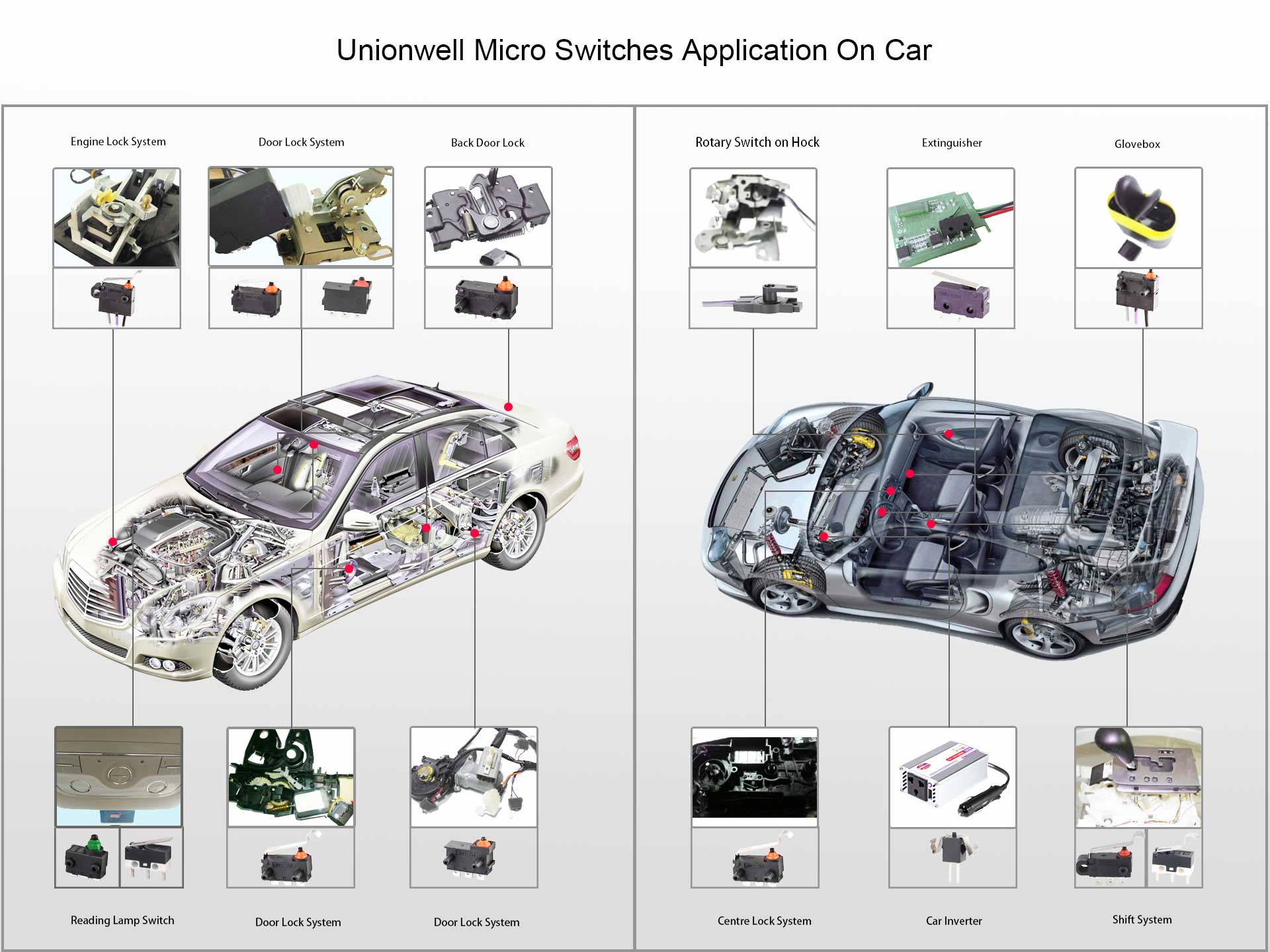
Automotive Door Lock Systems
In automotive door lock systems, micro switches are used to detect the real-time status of the lock mechanism and transmit unlock/lock signals to the control system. They can also detect unauthorized entry—such as forced opening or tampering—and send a signal to the alarm system, triggering the vehicle's audible alert.
Seat Adjustment Systems
In seat adjustment systems, specialized switches are utilized to control seat positioning, thereby enhancing passenger comfort and the overall user experience. Manufacturers offer a variety of options—including two-way and four-way switches—to meet the specific requirements of different vehicle models.
Charging Interface Systems
Within electric vehicle charging guns, micro switches serve to monitor the status of the charging interface, ensuring a stable connection and preventing accidental operation to enhance charging safety. They also function as the primary activation switch for the charging gun; the device will only operate normally once the user has correctly inserted the connector and triggered the internal mechanical mechanism.
Conclusion
Overall, despite their compact size, automotive micro switches play a pivotal role within vehicle systems. Through rapid response times, stable signal output, and highly reliable designs, they significantly enhance both overall vehicle performance and the user experience.
Their key advantages lie in their rapid response speed—making systems more responsive—their high reliability, which ensures stable long-term operation, and their extended service life, which helps reduce maintenance costs. As the automotive industry continues its evolution toward greater intelligence and electrification, the demand for high-performance switches is expected to grow steadily. Automotive micro switches—designed and manufactured by micro switch manufacturers—are poised to occupy an increasingly critical position in future vehicle systems, serving as fundamental components essential to elevating overall vehicle quality.
Applications of Refrigerator Door Switch in Home Appliances
Why Basic Micro Switch Is Essential for Garden Tools
Related Article