What's the Waterproof Micro Switch: Key Features, Structure, and Applications
In modern equipment, micro switches perform critical tasks such as motion detection, position confirmation, and safety interlocking. However, environments with moisture, condensation, oil, and even direct liquid splashes are extremely common. Therefore, waterproof micro switches have become standard components in many industries.
This article will provide a comprehensive explanation of waterproof micro switches from a popular science perspective. For engineers, purchasing personnel, or equipment manufacturers, this will help you understand the value, structure, working method, and key applications of waterproof micro switches from scratch.
Definition and Working Mechanism of Waterproof Micro Switch
Definition Explanation
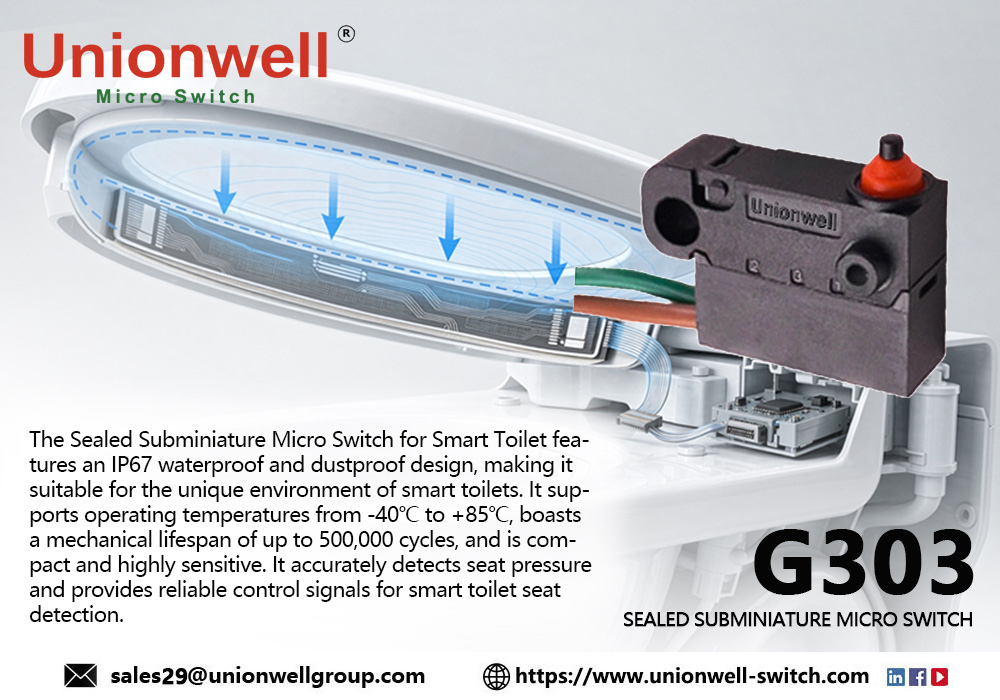
A waterproof micro switch is a micro switch that can reliably perform on/off actions in humid, condensate, liquid splash, or high-humidity environments. Internally, it still uses the fast-action mechanism of traditional micro switches, but protects the internal contacts through seals, O-rings, and potting structures to prevent malfunctions caused by moisture intrusion.
It is designed to withstand water vapor and moisture, condensate, liquid splashes, dust contamination, and environments with cleaning fluids and oil. This capability enables waterproof micro switches to maintain long-term stable operation in environments where ordinary micro switches cannot survive.
Fast-Action Mechanism Principle
The working mechanism of a waterproof micro switch is the same as that of a basic micro switch: When a device applies external force to the lever or button, the force is transmitted to the internal spring system;
When a critical point is reached, the snap-action mechanism generates a "momentary jump";
Then, the moving contact and the stationary contact instantly switch on and off, completing the entire operation of the waterproof micro switch.
This action has the following characteristics:
Extremely small trigger stroke (typically only 0.3–1.2mm), extremely fast action speed
Clear contact transition, effectively avoiding arc elongation and preventing misjudgments
High repeatability, strong stability, suitable for high-frequency operation
Why is a Waterproof Design Necessary?
Unsealed basic micro switches face the following risks in humid environments:
Contact corrosion: Moisture ingress causes oxidation of copper alloy and silver contacts, leading to unstable operation.
Short circuit risk: Liquid residue may create current paths between contacts, causing malfunctions or burnout.
Mechanical corrosion: Water corrosion of the springs or metal frames can lead to deviations in operating force.
Dust accumulation: Dust is more likely to adhere to the interior in humid environments, causing blockages.
Waterproof micro switches avoid these problems through a sealed structure, enabling them to maintain electrical stability and mechanical lifespan in harsh environments.
Structure of a Waterproof Micro Switch
Housing and Sealing Components
The housing of a waterproof micro switch is typically made of highly weather-resistant materials, including engineering plastics (PA66, PBT, etc.) and plastic shells (for industrial-grade protection). To form a complete waterproof system, these structures typically include: O-rings, sealing caps, epoxy or silicone potting compound, terminal sealant, and solder joint reinforcement. These components together form a multi-layered barrier to prevent liquid from seeping into the contact area and affecting overall performance.
How the Actuator Triggers Action
The actuator of a waterproof micro switch comes in various forms, typically including push-button, short-handle, long-handle, and roller-handle types, etc.
The triggering principle is as follows: Internal mechanical components push the actuator rod. The actuator rod transmits force to the internal metal spring. When the spring reaches a critical point, a snap-action transition is completed, achieving contact switching.
Waterproof actuator rods are typically covered with a rubber cap or employ a sealed encapsulation structure to ensure that the moving part of the actuator rod does not become a leak for moisture ingress.
Contact Assembly and Internal Mechanical Mechanism
The internal structure consists of moving contact, fixed contact, snap spring, and metal frame.
These precision components achieve "instantaneous transition" through extremely small mechanical movements, ensuring consistent contact response regardless of humid or high-temperature environments, reducing arc time, and improving contact life
Key Features of the Waterproof Micro Switch
Reliable Sealing Structure
Its reliability stems from multiple waterproof barriers:
Waterproof rings cover the actuator;
Top cover and bottom shell are laser-welded or ultrasonically welded;
PCB terminal block potting compound protects solder joints;
Terminal blocks are sealed with resin.
These structures not only provide waterproofing but also prevent dust, oil, and corrosive liquids, extending service life.
Precise Contact Response and Stable Actuating Force
The Waterproof micro switch maintains precise response even when sealed, thanks to key factors including:
Highly elastic metal materials maintain stable actuating force;
The sealed structure does not affect internal spring deformation or contact conditions;
Internal lubricating materials prevent changes in the coefficient of friction;
The waterproof cap structure does not alter the effective stroke.
Therefore, even in prolonged humid environments, the Waterproof micro switch maintains consistent operation.
High-Lifespan Structural Design
To ensure long-term use, micro switch manufacturers employ:
Silver alloy or gold-plated contacts to improve conductivity and corrosion resistance;
High fatigue-life materials for the contact springs;
Reinforced structures to prevent material fatigue caused by humidity;
Waterproof potting compound to reduce internal oxidation.
These technologies allow waterproof micro switches to withstand millions of mechanical actions and long-term electrical loads, enabling them to perform well in various environments.
Applications of Waterproof Micro Switches in Different Fields
Usage Scenarios in Home Appliances
Washing Machines
Waterproof micro switches are commonly used for "door lock detection" or "water level detection."
When the washing machine door is closed, the door latch mechanism presses the switch lever, triggering the internal contacts to close and sending a "door closed" signal to the control board, allowing the program to start. The waterproof structure ensures that the mist and moisture generated during the washing machine's spin cycle do not affect the detection accuracy.
Dishwashers
Inside dishwashers, waterproof micro switches are mainly used to detect whether the bottom water level has reached a safe value. When the water level reaches a certain height, the dishwasher applies force to the waterproof micro switch through another device, causing it to switch contacts and stop adding water to prevent overflow. Sometimes the water vapor temperature can reach 80°C, so a waterproof sealing structure is crucial to prevent the contacts from being corroded by steam.
Applications in Automotive Electronic Systems
Door Locking System
When a door closes, the metal lever in the locking mechanism triggers a waterproof micro switch, causing it to output a "closed" or "open" signal for use in interior lights, dashboards, alarm systems, etc.
Trunk Control System
When the trunk is closed, the switch immediately detects the action. If it is not closed tightly, the vehicle will issue a warning, reminding the user to check again.
Applications in Industrial and Outdoor Equipment
Industrial Machinery: Waterproof micro switches are used for button detection, limit protection, and safety linkage.
For example, when a robotic arm moves to a designated position and touches the switch trigger, the switch immediately provides feedback on the position status, unaffected by oil or moisture.
Outdoor Monitoring Equipment: Including weather stations, outdoor traffic lights, automatic door systems, etc., these devices are often exposed to rain, fog, and temperature variations. Waterproof micro switches ensure that the equipment maintains a stable signal under extreme humidity conditions, preventing leakage or false triggering.
FAQ
Q1: What does IP67 mean? What is the practical significance of this for micro switches?
A1: IP67 indicates complete dust-proof protection and short-term immersion in water (generally 1m depth, 30 minutes), suitable for equipment frequently exposed to rain or short-term immersion.
Q2: Will waterproof micro switches fail in low-temperature environments?
A2: If the operating temperature range (e.g., -40°C to +85°C) was considered during selection, they will not fail due to low temperatures under normal use.
Q3: How to determine if a waterproof micro switch is suitable for high-vibration environments?
A3: Check the product's vibration and shock test data (e.g., vibration frequency, amplitude) and automotive/industrial certifications. If it meets the requirements, it can be used in high-vibration environments.
Q4: What are some easily overlooked precautions when installing waterproof micro switches?
A4: Avoid cutting or deforming the sealing ring during installation; avoid damaging the potting compound during terminal soldering; ensure the actuating rod fits well with the external structure and does not generate lateral forces.
Q5: If the equipment is exposed to rain for extended periods after leaving the factory, does the waterproof micro switch still need regular inspection?
A5: Frequent inspections are not necessary, but regular checks of the seals, terminals, and operational consistency are recommended. Replace the switch promptly if seal aging or abnormal operation is detected to prevent potential malfunctions.
Conclusion
Waterproof micro switches, with their superior sealing structure, high stability, and long lifespan, occupy an irreplaceable position in home appliances, automobiles, industrial, and outdoor equipment. From structure and operating principles to applications, waterproof micro switches embody the deep demands of modern electronic control systems for stability, durability, and security. For any equipment that needs to operate in humid or liquid environments, choosing a waterproof micro switch designed by a micro switch manufacturer is a crucial step in ensuring equipment performance.
A Beginner's Guide to Keyboard Switch: Understand the Inside Structure and Work Principle
What Is a Basic Micro Switch? Everything You Need to Know
Related Article