Seat Belt Reminder Switch Applications in Modern Automotive Safety Systems
With the continuous evolution of automotive safety concepts, vehicle safety systems have gradually shifted towards a comprehensive safety architecture of "active reminders + passive protection synergy." Among these, the seat belt reminder system, as the most fundamental and directly impactful functional module affecting occupant safety behavior, has become an indispensable part of modern automobiles.
Therefore, regulations in many countries highly recommend "seat belt wearing status detection and reminder" as a standard feature. The seat belt reminder switch plays the role of the signal source. It determines whether the system can accurately identify the "wearing" and "not wearing" status. If this signal is misinterpreted, the entire reminder system becomes meaningless. Therefore, the application value of the seat belt reminder switch in modern automotive safety systems cannot be ignored.
What Is a Seat Belt Reminder Switch in Automotive Systems
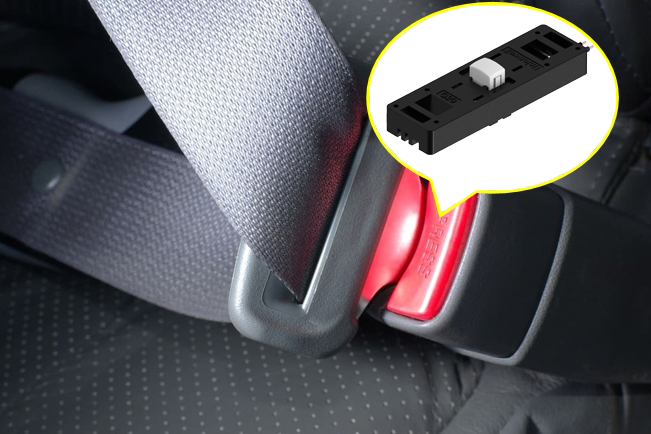
A seat belt reminder switch is a mechanical status detection switch specifically designed to detect the seat belt buckle status. It is typically integrated within the seat belt buckle assembly to determine whether the seat belt insert is correctly inserted and locked.
In automotive safety systems, the core function of this switch is not to carry current or control loads, but rather to provide a clear status signal. When the seat belt is inserted into the buckle, the internal mechanical structure shifts, triggering the seat belt reminder switch and sending a signal to the BCM system. When the seat belt is removed, the switch resets, and its state changes accordingly, determining whether to trigger the alarm module.
In this application scenario, the snap-action structure unique to the micro switch demonstrates a significant advantage. It can achieve rapid and precise contact switching within a very short travel, avoiding "partial triggering" or ambiguous states, making it ideal for the seat belt's status detection requirements of immediate confirmation upon insertion and immediate reset upon removal.
Why Seat Belt Reminder Switch Is Essential for Automotive Safety
The seat belt wearing status directly affects the passive safety performance of a vehicle in the event of a collision. If the seat belt is not worn correctly, occupants may suffer serious injury due to inertia. Therefore, the core objective of a seat belt reminder system is to guide drivers and occupants to adopt correct safe behaviors through timely and accurate reminders.
Currently, many countries and regions have made seat belt reminder systems a quasi-mandatory feature, imposing clear requirements on their reliability. This means that the seat belt reminder switch must remain stable throughout the entire vehicle's lifespan. Only when the seat belt reminder switch accurately reflects the actual wearing status is subsequent instrument panel warnings, audible alarms, or system recordings meaningful. Situations such as no reminder when actually not wearing a seat belt, continuous alarms when actually wearing a seat belt, delayed status recognition, or vibrations all pose potential safety hazards to driving.
Therefore, the reliability of the seat belt reminder switch is directly related to the credibility of the safety system. If the switch malfunctions or misoperates, the driver may lose trust in the entire reminder system and thus ignore genuine safety warnings.
Seat Belt Reminder Switch Application in Modern Automotive Safety Systems
In modern vehicles, the seat belt reminder switch is typically installed inside the seat belt buckle, directly linked to the latch locking mechanism. This installation method ensures that the switch action is highly consistent with the actual seat belt status, avoiding misjudgments caused by external interference.
From a system architecture perspective, the signal output from the seat belt reminder switch is usually transmitted to the following modules:
- Instrumentation system: Illuminates the seat belt indicator light to remind the driver that someone is not wearing a seat belt.
- Body Control Module (BCM): Used for specific logic judgments and signal management.
- Audio alarm module: Triggers a buzzer or voice reminder at the passenger seat.
In multi-seat configurations, each seat is equipped with an independent seat belt reminder switch. The system achieves precise seat belt reminders down to the "specific seat" by monitoring the signals from each seat separately. This requires that switches in different locations exhibit consistent triggering characteristics under the same insertion force and travel conditions.
How a Seat Belt Reminder Switch Works in Seat Belt Detection
From a logical perspective, the operation of a seat belt reminder switch is intuitive, but it places extremely high demands on structural design. When the seat belt insert is inserted into the buckle, it pushes an internal lever or slider, causing displacement. This mechanical displacement is transmitted to an internal micro switch.
Once the displacement reaches the preset trigger stroke, the snap-action structure inside the micro switch causes the spring to flip instantaneously, changing the contact state and generating a clear electrical signal output. This signal is then transmitted through the wiring harness to the vehicle control system, where the system performs logical judgment and executes the corresponding reminder action. When the seat belt is pulled out, the mechanical structure resets, and the switch returns to its initial state.
Signal Logic of a Seat Belt Reminder Switch
In practical applications, the seat belt reminder switch can employ normally open or normally closed logic, depending on the vehicle's electrical design. Regardless of the logic used, the core requirement is that the state change must be synchronized with the actual seat belt movement.
Performance Requirements of Seat Belt Reminder Switch in Automotive Use
The automotive environment places extremely high performance demands on seat belt reminder switches. First, there's the issue of mechanical lifespan. Seat belts undergo numerous insertion and removal operations throughout a vehicle's lifespan, requiring the switch to maintain stable performance under high-frequency repetitive action.
Second, there's the electrical lifespan. Although seat belt reminder switches carry relatively small currents, prolonged state switching can still affect the contacts, thus impacting signal quality.
Furthermore, vehicles inevitably experience vibrations during operation and face environmental challenges such as temperature variations. The switch must maintain consistent triggering under these conditions and avoid malfunctions due to changes in the external environment to ensure accurate judgment.
Why Micro Switch Technology Is Widely Used in Seat Belt Reminder Switch Design
The widespread use of micro switches in seat belt reminder switch design among numerous switching technologies is no accident. Its core advantages lie in its high trigger accuracy and the precise state switching provided by its snap-action structure.
The snap action structure allows for contact flipping within a very short travel, enabling the switch to quickly switch states upon insertion or removal, avoiding ambiguity. This is particularly important for seat belt detection, as the system cannot tolerate uncertain states such as "partial insertion."
Furthermore, the consistent performance of micro switches in mass production is well-suited to the automotive industry's requirements for scalability and stability. From a manufacturing perspective, its mature structural design and process control make it an ideal core component for seat belt reminder switches.
Conclusion
Overall, the seat belt reminder switch is a key component in modern automobiles. It provides a reliable signal foundation for the entire safety reminder logic by accurately detecting the seat belt wearing status. The proper placement of the seat belt reminder switch within the seat belt buckle and its stable coordination with the vehicle control system are crucial to ensuring the effective operation of the reminder function. Its structural design, trigger consistency, and long-term reliability directly determine the actual safety value of the system.
From the perspective of micro switch manufacturers, a highly consistent and reliable structural design is not only a reflection of product competitiveness but also a direct response to automotive safety responsibilities. Only by achieving stability and reliability at the level of basic components can modern automotive safety systems truly fulfill their due protective function.
What Is a DPDT Micro Switch and How Does It Work?
Why SPDT Micro Switch Is Becoming So Common in Modern Control Systems
Related Article