Why Industrial Micro Switch Is Essential for Production Lines
Modern industrial production lines are constantly evolving towards automation, intelligence, and high speed. Mechanical equipment needs to perform position detection, motion confirmation, work-piece transfer, and operational control during continuous operation. In automated assembly, conveying, packaging, processing, and material sorting equipment, the accuracy of any mechanical action can affect subsequent processes.
In production lines, the industrial micro switch provides clear status feedback through its straightforward operating logic. This article will focus on the working method, main applications, and significant value of industrial micro switches in automated production lines, helping readers better understand the crucial role of this small component.
Why Industrial Micro Switch Is Important for Production Lines
Automated production lines typically consist of mechanical equipment, conveying systems, actuators, controllers, and detection elements. These modules need to operate collaboratively according to a program. To ensure stable production processes, the control system needs to continuously acquire equipment status information, such as whether the mechanical mechanism is in position, whether the work-piece has completed its movement, whether the actuator has reset, and whether the equipment needs to continue operating.
Industrial micro switches are primarily used for mechanical status detection and signal feedback in this process. When a component moves to a designated position and triggers the actuator, the internal contacts of the micro switch change, outputting a status signal to the control system. The system determines the current state based on feedback and executes the next control logic step.
Accurate state detection reduces equipment malfunctions, missed actions, and control anomalies, improving production efficiency and operational stability. For automated production lines operating continuously for extended periods, reliable industrial micro switches have a significant impact on equipment performance and maintenance costs.

How Industrial Micro Switches Work in Automated Production Lines
Industrial Micro Switches Convert Mechanical Movement into Electrical Signals
The basic workflow of an industrial micro switch in production equipment is: mechanical component movement → actuator triggering → contact switching → output signal → control system executes the next action. In automated equipment, it is often used to detect mechanical position and motion status. For example, when a slider moves to its endpoint and triggers the micro switch's actuator, the PLC can determine the equipment status based on the feedback signal and control the motor to stop or start the next process.
Furthermore, industrial micro switches can connect mechanical structures and control systems to achieve motion recognition and status feedback. With its precise trigger position, rapid response, and snap action mechanism, it helps production lines improve motion connection efficiency, ensuring seamless and stable operation of automated equipment.
Industrial Micro Switches Provide Reliable Position Feedback
Automated production lines require control systems to understand equipment status in real time, and industrial micro switches can provide accurate position feedback to PLCs or controllers. In practical applications, it is mainly used to detect the positioning of mechanisms, equipment reset, and changes in work-piece position. For example, in automated assembly equipment, after the mechanical slider moves to its endpoint, it triggers the micro switch. The PLC confirms the completion of the action based on the feedback signal and controls subsequent clamping, assembly, or movement processes.
Furthermore, the micro switch can also detect whether the equipment has returned to its initial position, ensuring a normal start-up for the next production cycle. Since production lines typically require high-frequency continuous operation, the switch must maintain stable and consistent triggering performance. Its mechanical lifespan, motion accuracy, triggering force, rebound performance, and contact reliability all directly affect equipment operating efficiency and production stability.
Major Applications of Industrial Micro Switches in Production Lines
Industrial Micro Switch for Machine Position Detection
Sliders, robotic arms, actuators, and moving components in industrial equipment require accurate position detection. Industrial micro switches can be installed at designated locations. When a mechanical component reaches its target position, its internal contacts switch and output a signal to the control system, thus determining whether the equipment has completed its current action.
In automated equipment, industrial micro switches are commonly used for detecting end effectors of robotic arms, slide positioning, cylinder stroke, and mechanism reset. For example, after a slide in an automated assembly line completes its movement, the PLC can confirm its positioning via feedback signals before executing subsequent processing, avoiding positional deviations or equipment interference.
Industrial Micro Switch for Conveyor Systems
Conveyor lines require continuous monitoring of work-piece passage, positioning, and status. Accurate position feedback is a crucial foundation for the stable operation of automated sorting, assembly, and packaging systems. Industrial micro switches can be used in conjunction with mechanical stops, trigger levers, and other structures. When a work-piece moves to a designated position, it actuates the micro switch, switching internal contacts and outputting a detection signal to the control system.
As a limit switch, it is commonly used for work-piece positioning detection, conveyor control, and sorting triggering. For example, on an automated packaging line, when a work-piece enters a designated area, it triggers the micro switch. The PLC, based on the feedback, pauses the conveyor belt and starts the packaging process, resuming operation after completion. This detection method has simple logic and can achieve clear position determination.
Industrial Micro Switch for Automated Machinery
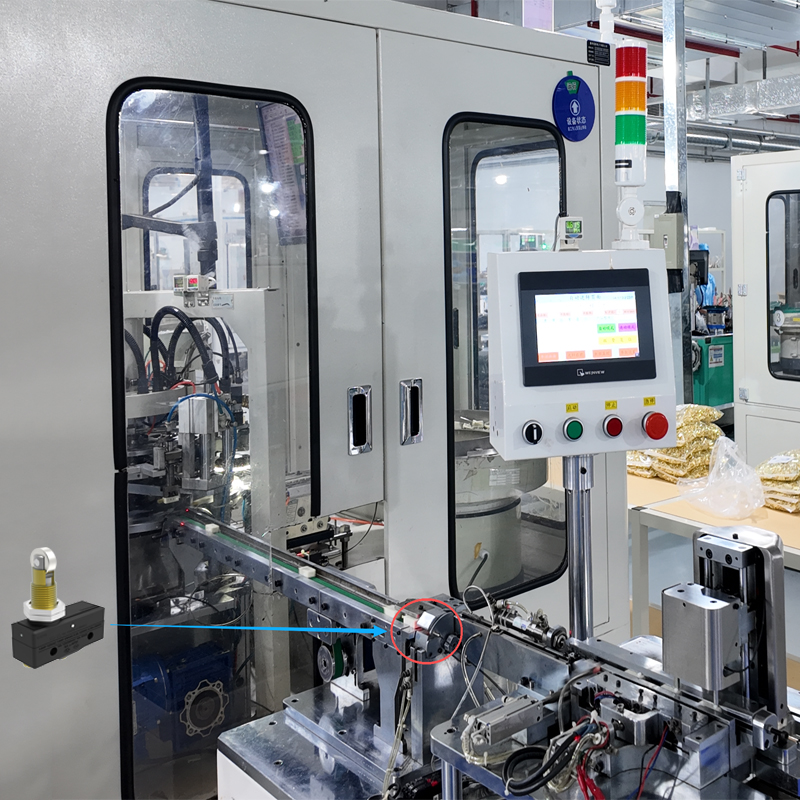
Automated equipment contains numerous repetitive motion mechanisms, requiring high levels of position detection and motion feedback. Robotic arms, assembly equipment, packaging equipment, and processing equipment all need to detect the endpoint of motion, mechanism reset, or completion of actions. Industrial micro switches can be installed in these critical locations as signal interfaces between the mechanical structure and the control system.
After a robotic arm completes a fixed action, its position status can be fed back via a micro switch; similarly, the clamping or releasing of fixtures in assembly equipment can be detected using a switch. Packaging and processing equipment can use a micro switch to confirm whether the mechanism has returned to its initial position or reached the limit point, which is very helpful for equipment manufacturers to install and maintain.
Industrial Micro Switch vs Other Detection Solutions
Modern production lines utilize various detection solutions, including mechanical switches, photoelectric sensors, and proximity sensors. Industrial micro switches are suitable for production equipment requiring direct detection of mechanical motion, clearly defined trigger positions, and limit states.
Industrial micro switches offer clear trigger positions and, with proper installation and design, can be used for limit detection, mechanism reset, and motion confirmation. Furthermore, the simple output signal of a micro switch can be directly used as an ON/OFF input for a PLC, reducing the need for complex signal processing. Its compact structure also facilitates installation in confined spaces and adapts to repetitive mechanical movements.
However, industrial micro switches are not suitable for all scenarios. For equipment requiring long-distance, non-contact detection or target recognition, other detection solutions are more appropriate. Therefore, the selection process should consider factors such as detection distance, installation space, action method, working environment, and control system requirements to determine the appropriate solution.
Conclusion
Industrial micro switches are triggered by a mechanical structure, and internal contacts enable rapid switching, converting the mechanical motion of the equipment into electrical signals. Whether for mechanical position detection, work-piece positioning on conveyor lines, or motion confirmation in automated assembly, packaging, and processing equipment, industrial micro switches can serve as critical detection nodes in the production process.
As industrial automation continues to increase, the demand for detection components with long lifespans, high consistency, and high reliability will continue to grow. For equipment manufacturers, choosing a micro switch supplier with R&D capabilities, precision manufacturing processes, and a rigorous quality control system will help build more stable and efficient automated production equipment.
The Role of Sealed Mini Micro Switch in Pickup Truck Transmission Systems
The Evolution of Refrigerator Door Switch: From Simple Design to Smart Control
Related Article