How Does a Sealed Micro Switch Work in a Car Charging Port Cover?
With the increasing popularity of new energy vehicles, the Car Charging Port has become a crucial external interface in vehicle electrical systems. Unlike gasoline vehicles, new energy vehicles require a charging port to establish a power connection between the vehicle and the charging equipment. Therefore, the charging port cover not only serves a mechanical function of protecting the charging port but also needs to maintain stable performance during daily use.
This is precisely where a sealed micro switch comes in. It can be installed near the mechanical structure of the charging port cover, triggering the switch through mechanical displacement generated by the cover plate, linkage, cam, or other transmission structures. This article will analyze the basic structure, triggering process, and installation methods of the sealed micro switch to help readers understand how it can be applied to the Car Charging Port Cover.
What Is a Sealed Micro Switch?
A sealed micro switch is a micro switch with a sealed structure. It uses an external mechanical mechanism to drive an actuator, causing internal contacts to switch rapidly and output an electrical signal, completing circuit switching.
Compared to other switches, its core characteristics are a clearly defined trigger position and rapid response. For a car charging port cover, a properly installed micro switch allows the cover plate to trigger the switch at a designated position, thus achieving stable position detection. A sealed micro switch mainly consists of the following parts:
- Switch Housing: The external structure of the entire switch, used to secure internal components and provide some protection.
- Actuator: The part connecting the external mechanical mechanism and the internal mechanism. When the actuator moves to a specified stroke, the internal mechanism will produce the corresponding action.
- Spring Mechanism: Provides the spring force, allowing the actuator to return to the corresponding position after the external mechanical action is released.
- Internal Contacts: Responsible for electrical state switching. When the actuator is pushed to a specified position, the internal contacts make contact or separate, changing the circuit state.
- Terminals: Transmit the electrical state of the switch's internal components to the external circuit.
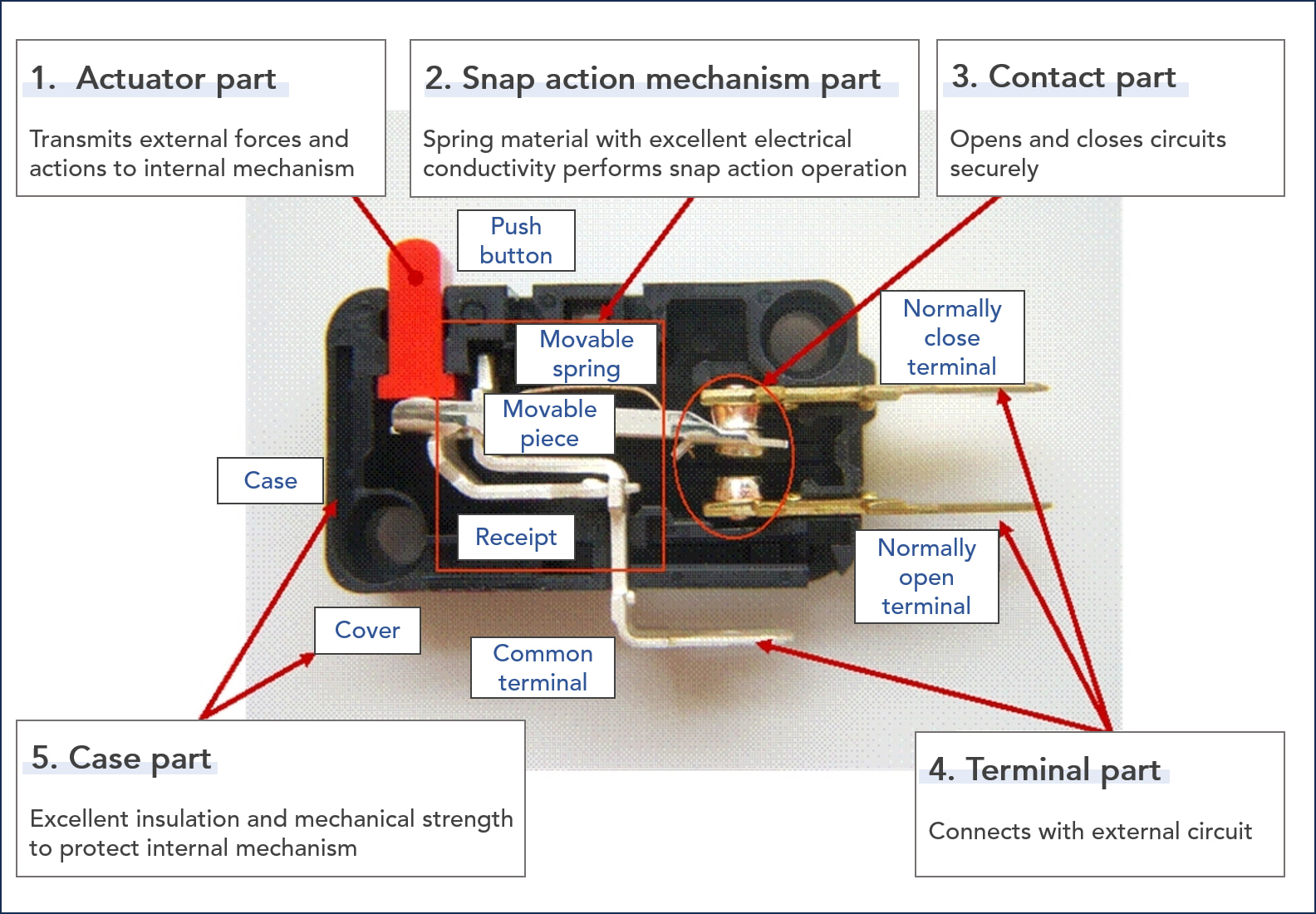
Therefore, the actual operation of a sealed micro switch is accomplished by the mechanical triggering structure, the internal actuation mechanism, and the electrical connections. For the charging port cover, the mechanical displacement of the cover plate ultimately needs to be converted into a stable contact state by the actuator.
Why Sealing Matters in Automotive Charging Port Applications
Automotive charging ports are located on the exterior of the vehicle body and may be exposed to rain, moisture, dust, mud, and road pollutants during daily driving. Therefore, detection switches installed near the charging port cover must possess a certain degree of environmental adaptability.
Sealed micro switches employ a sealed structure, reducing the possibility of external environments entering the internal mechanisms, thus helping to protect critical components such as internal contacts and spring mechanisms. For automotive installation locations with high requirements for moisture and external environmental adaptability, these waterproof micro switches offer a more suitable detection solution. Their sealed structure helps maintain the switch's long-term stable mechanical operation and electrical state, rather than simply serving as a product label.
How Does a Sealed Micro Switch Work in a Car Charging Port Cover?
The sealed micro switch converts the mechanical displacement of the charging port cover into an electrical signal. During the opening and closing of the charging port cover, the cover itself or the connecting mechanism pushes the micro switch's actuator; when the cover reaches a predetermined position, the actuator triggers an internal mechanism, causing the contacts to switch and output the corresponding electrical state.
Charging Port Cover Movement Activates the Micro Switch
The charging port cover may employ a rotating cover, linkage, or cam mechanism, therefore the installation position of the sealed micro switch needs to be designed based on the actual movement trajectory. Regardless of the structure used, the core principle is to ensure a correspondence between the actuation position and the mechanical position that the cover needs to detect.
During the design, the actuator's stroke, operating force, installation tolerances, and trigger position must also be considered. Otherwise, triggering too early may result in premature output of a shutdown signal, while triggering too late may affect the timeliness of state detection. Therefore, the design of the mechanical trigger point is crucial to the entire detection scheme.
The Internal Contacts Change the Electrical State
When the charging port cover pushes the actuator, the spring mechanism and contact structure inside the micro switch activate, causing the internal contacts to switch states. The basic process is: Charging Port Cover Movement → Actuator Movement → Internal Contact Switching → Electrical Signal → Vehicle Control System
Internal contact switching completes the transition from mechanical to electrical state. When the cover is closed, the actuator is pushed and outputs the corresponding state; when it is open, the external action is released, the actuator resets, and the contacts return to the other state. In summary, the sealed micro switch mainly outputs a clear ON/OFF signal, suitable for determining whether the charging port cover is in position.
Sealed Micro Switch Provides Position Feedback
Vehicle control systems require position feedback from the charging port cover to confirm whether the cover is in the correct state (e.g., fully closed, open, or in a designated position). The sealed micro switch can form a clear detection node through mechanical triggering. When the cover closes and pushes the actuator, the switch changes state; when it opens, the action is released, and when the actuator resets, the contacts return to the other state.
This feedback can be used to determine whether the charging port cover is closed or open, and whether the relevant mechanism has completed its action. However, the sealed micro switch is primarily responsible for mechanical state detection and electrical signal output; how the signals are used by the vehicle is determined by other systems such as the Vehicle Control System and the Controller. Therefore, its more accurate role is that of a signal interface between the cover's mechanical structure and the vehicle's electronic systems.

Where is a Sealed Micro Switch Installed in a Car Charging Port Cover?
There is currently no unified standard for the installation location of a sealed micro switch, which mainly depends on the mechanical structure of the car charging port cover. Commonly, it is installed near the cover's movement path, allowing the cover or connecting mechanism to trigger the actuator at a designated position.
Furthermore, three aspects need to be considered during design:
- Installation space: The switch size should match the housing, mounting structure, and surrounding parts;
- Trigger stroke: Ensure the actuator can fully operate when the cover is in position, while avoiding excessive compression;
- Mechanical tolerances: Dimensional deviations of the cover, linkage, and switch need to be comprehensively considered to avoid misalignment of the trigger position.
Therefore, when selecting a micro switch, a comprehensive evaluation of switch size, actuator type, actuation position, operating force, and mounting configuration should be conducted to ensure a stable correspondence between the mechanical position and the micro switch's trigger state.
Conclusion
The sealed micro switch in a car charging port cover primarily performs position detection, mechanical status confirmation, and electrical signal feedback functions. For micro switch manufacturers, developing sealed micro switches for automotive charging port covers requires more than just focusing on product size or single electrical parameters. It also necessitates considering mechanical structure, electrical connections, sealing design, trigger consistency, lifespan, and mass production precision.
With the increasing number of new energy vehicles and the rising frequency of charging interface usage, only by combining precise mechanical design, reliable contact structure, sealing processes, and rigorous manufacturing quality control can sealed micro switches maintain long-term stable detection performance in automotive charging port covers.
What Is the Future Development of Snap Action Micro Switch?
The Role of Sealed Mini Micro Switch in Pickup Truck Transmission Systems
Related Article